10 May 2019
Hitting the Bottom(s)
I really wanted to hit the Bottoms this week. And no, that’s not a grammatical, usage, or punctuation error, it’s just a pun that stands in for a quest to overcome a small bit of nastiness in the world. So to continue with the pun, they say you have to hit Bottoms to see what’s important and to start the fight back. I somewhat non-concur. I had to fight just to hit Bottoms.
Right, he’s truly lost it, I hear you saying. So, let’s back up a few days.
Recovery from Boston wasn’t pretty, though it really had little to do with Boston. Any soreness from that adventure peaked, as usual, a couple days hence, and quickly subsided, but a general malaise set in that went beyond the usual joint complaints and instead rose to a general alarm complaint. About a week back I turned in the closest thing to a tempo run since Beantown, circling Portland Maine’s Back Cove a couple of times, one of my favorite spots to hit after a northern customer meeting. My pace wasn’t horrid, but to think that it was all I could muster, and to think of the ugliness that accompanied the effort, well, it just wasn’t right. It seemed pretty clear that the meds that Lady Doc had directed – the ones that killed me back in February and I’d abandoned till after Boston, but then being a duly compliant patient had in fact restarted right afterwards – were at it again. Having failed to qualify at Boston and with my second chance race, Sugarloaf, a scant two weeks out, I pulled the plug on the pills once again.
A mere two days later I toed the line (well, sort of, since there was no line at the start to toe and they didn’t bother let us all get into the road before calling ‘go’, but I digress…) at Foley’s Backstreet 5K, a decent-sized local event that our local club had descended upon en-masse last year, and had so much fun that we descended again en-larger-masse this year. I could harp about how I pulled in over a minute slower than last year’s outing despite ideal conditions, but that would skip the important bits: first, that a couple hundred meters in it was clear that I actually felt good for the first time since Boston, second, that while not blazing, I maintained the intensity, rolling back late-race challenges by a pair of youngsters, and third, that I actually had the oomph to kick it in, avoid a get-passed-at-the-finish-line insult, and score a finish line photo in which I am not, for a change, exhibiting my usual death-warmed-over look. Oh, and I took the old farts’ division, much to the chagrin of my club-mate who, like last year, would have owned that title had he not invited me along. Next year he’ll probably keep quiet about this one.
Next up after Foley’s on Sunday was an early Monday foray to a Company Rah-Rah (which, to be fair, turned out to be a pretty good Rah-Rah) in Nashville, Tennessee. Aha, that light bulb just went on; you frequent readers probably have an inkling of where this is going. Yes, a traveling runner story, with a twist.
On the ride home from Foley’s, my carpooling club-mates, who’d just visited Nashville a few weeks prior, suggested getting in a run at the Shelby Bottoms Greenway, a roughly four-mile-long stretch of green, trails, and more green, hugging the Cumberland River almost directly across from my home away from home for the next few days, the truly gargantuan Gaylord Opryland hotel. The Gaylord, one of the biggest non-casino hotels in the country, is a combination convention factory and adult Disneyland. It features at least three glass-enclosed climate-controlled atria, the largest of which could probably hold several Midwestern towns in entirety. Every detail is attended to, every plant perfectly coifed, every faux waterfall perfectly designed, even the walkways are varnished with some magical substance that makes them always sport an ‘it just showered and things are pleasantly damp and shiny’ look while remaining remarkably non-skid. And it would turn out that the staff was top-notch and the food was almost uniformly excellent (smoked brisket hash! – a food providing the perfect way to die and inspiring my social media idea… #hashtag). Everything in the facility was top shelf. But everything was in the facility. These places are designed to be the hospitality equivalent of Alcatraz. You’re not supposed to leave. Indeed, it’s very hard to leave, at least without motored conveyance.
But I run. I insist that I leave. I want to see the real world on the outside, the tour from ground level. And I’m not satisfied with the one-point-four-mile all-sidewalk round-the-hotel jogging loop they offered up on my arrival, neatly packaged in a pocket-sized brochure with the warning that this was urban running and that all due caution should be taken. Blech.
But on Sunday afternoon, I didn’t yet know about that neatly packaged three-inch brochure. What I did know was that no amount of Internet searches would turn up any decent places to run from the Gaylord Opryland (though to my amusement I did find this page which highlights the worst cities to run in, four of the five of which I’ve previously railed about in this column). I also knew that the resort occupied a slim strip of pavement hemmed in by the river and an eight-lane freeway. I further knew that there were some non-descript roads by which I could escape to north, though with no apparent destination or scenery. But mostly I knew that I wanted to take advantage of my friend’s recommendation and make my way to Shelby Bottoms to enjoy all that green, which meant escaping to the south and crossing the river. The problem was getting there.
The City of Nashville did its part to solve my problem. A bit over a decade ago they built a lovely pedestrian suspension bridge from the Bottoms to the Opryland side of the river. Google Maps then served up hope in the form of a small road that paralleled the freeway and connected the south end of the Opryland resort-cum-hotel-cum-mall-cum-behemoth to a tiny rotary where the trail from Shelby came off the pedestrian bridge and plunged into a tunnel to parking lot across said freeway. Other than the need to hop down from the roundabout onto the trail, which appeared pretty easy, it looked like a win. Two miles from my hotel room would put me across the river with miles and miles of both paved and unpaved trails – and lots and lots of green. An early morning start would give me time for a fine tour of the Bottoms and still get me back for the Rah-Rah.
Except for one little problem. Well, two, to be precise.
That little road was actually the entrance to a building housing Ryman Hospitality Properties. (You’ll understand why I’m calling them out by name shortly.) And a quick peek at Google Street View turned up a big issue: that little road was guarded by spiked iron gates at both ends, hermetically sealing off Ryman from the rabble of the real world. While it looked likely I could get around the one on the south end, resplendent with open lawns, the one on the north end was embedded in deep, thick woods, thwarting any attempt to circumvent its distinct lack of hospitality; rather ironic for a company whose name is hospitality.
A study of the map showed that no reasonable alternative routes existed. To cross over the freeway from the hotel would involve, besides a lot of busy and highly unpleasant intersections, a crazy-long detour that would make the round-trip to the bridge a long run in its own right. No, there was no alternative but to breach the ramparts.
Now don’t get me wrong here. I’m not being so pompous as to claim that as a runner I have any special rights to cross someone’s private property. Of course I don’t. But here’s an interesting little detail: Ryman, it turns out, owns Opryland. The hotel (Marriott only manages it). The music hall and famed show. A bunch more places. So Ryman, in the hospitality business, is sealing itself off from its own customers, a most inhospitable stance. We love you, or at least your money. Now don’t bother us.
In part, I get it. If you look at the map, you can understand why they wouldn’t want vehicular traffic coming down the road. It’s small. It’s not designed for volume. And when things happen at Opryland, they happen big. It really would be unpleasant to try to empty out a show, the mall, or a convention through their driveway, especially if the freeway backed up and people bailed for this alternative. So that part makes sense.
But nobody would pass this way on foot, save a few fitness crazies like me. Nobody would leave a performance at the Grand Ol’ Opry and try to walk back to downtown Nashville. It’s a long, long way (and it’d probably be very dark). Nobody would walk from the mall with their shopping treasures in hand. There’s nothing on the other end, save that bridge to the greenway, and once you’re there, there’s nothing there either, again, for a long, long way. And the southern end appeared (and I’d confirm later) to offer plenty of ways around the gate, so this blockade wasn’t adding any level of facility security. So why not allow pedestrians to pass, at least during daylight hours? Isn’t the point of the greenway to provide accessibility to outdoors? Isn’t the point of a hospitality business to provide a pleasant experience to their customers?
Before I slept Sunday night, I was already roiling at the irony. Here was a city that had made an effort not only to preserve open space, but to make it accessible by building a bridge (and a big and costly one at that, mind you), only to have that wonderful resource be put off-limits to their biggest point-source of visitors and tourist and convention revenue – by the very firm that was drawing those people in. It’s a wound inflicted by their own benefactor. It’s the antithesis of what enlightened civic leaders strive for. Readers of this column will recall just three months ago in A Tale of Two Cities my praise for what Austin, Texas has created, and how their work has transformed their city by slathering it with a sizable dose of healthy lifestyle, and it has paid back in spades. Nashville is trying, but they’ve been blocked at the ten-yard-line by a member of their own team.
But I’ve jumped ahead and made a lot of conclusions before spelling out the story, so, let’s back up.
Owing to what I’d learned in my pre-trip research, I arrived in Nashville with an agenda, no, make that a mission, seasoned with a relish of indignance. Fight the injustice! Free the Bottoms! On check-in, the Gaylord’s front desk was a bit flummoxed by my ask of a way to get to the greenway and sent me to the concierge. Once there, I thought I’d hit the jackpot when Concierge The First not only understood my plight and seemed to have a solution, but doused her answer in passion for my cause. Enlightenment! Yes, she said, you can get around that gate through the woods (foolish me, having seen the barrier only from a distance on Street View, I thought the method would be obvious and didn’t ask further details), and further, she said she’d been working with the city to open up the very access I sought. Hallelujah! There is hope for the world!
And so I duly dragged my stiff and aged butt out of bed the next morning and made it out the door a few minutes after six, which those who know me know is not a time I prefer to be active. I worked out the kinks while traversing the acres of parking lot that offered the shortest route south. Reaching the resort’s southern terminus, just before the resort road melded into the mega-freeway, off in a last forlorn lot to the right… yes, there it was. The Gate of Unwelcoming, the Portal of Prohibited Passage. And to my surprise, a Gaylord pickup truck was in front of it, and it was open. The Evil Empire making rounds perhaps? As I approached, the truck rolled through, and the gate started to swing slowly shut.
I contemplated making a dash. I could have made it. But if I did (and if nobody shot me) I would still have to get back. Scaling the spikey thing was not an option. If I couldn’t return, I certainly wouldn’t make it back in time for the Rah-Rah. And we’d been read the riot act that we would be at the Rah-Rah on time.
I let it swing shut, and when the truck was long gone, surveyed the scene. A Most Unwelcoming Sign warned that trespassers would be eaten by angry hippos (yeah, I made that part up, but it was unwelcoming). Fences along the road melded gapless with the gate, and southern-style-thick foliage extending on both sides. But the fence along the road only ran for perhaps twenty feet, and it almost looked trodden behind it. This, I surmised, must have been the ‘through the woods’ that Concierge The First had spoken of. I swung myself around the end of the fence and, clinging to that barrier to avoid the poison ivy and the slight drop into even thicker poison ivy, made my way to the gate – only to find Yet Another Fence, this one extending outward from the gate directly into the thick, no end visible, no trodden path, passage thwarted. Well, at least I wouldn’t get eaten by angry hippos. Extracting myself from the fences, I circled the small lot from whence the fence commenced, and finding no trodden paths into the thick, considered myself repelled but not defeated. I retreated, took a tour of the soft yellow underbelly of the resort (the service and warehouse district, so to speak), and popped in a few more miles by popping out the north end into a residential road amusingly signed to repel RVs.
Back to the drawing boards. Concierge The First happened to be off that day, so my next effort landed me with Concierge The Second. Once again, the effort and caring offered up was second-to-none. Second got creative, explored several transit options, and went so far as to offer that she’d personally drive me down there (at 5:45 AM!) which I politely declined since it kind of subverted the point of the quest, and more importantly, since I could have permanently contaminated her seat cushions on the ride back. But key to this story is that she got on the phone and called our now mutual nemesis, Ryman (Non-)Hospitality, expecting that a reasonable request from a reasonable person would get a reasonable response. Expecting to hear that yes, we keep that locked to keep crowds of vehicles at bay, but sure, you can run through, since there will never be a full marathon crowd passing by, or maybe we can offer you a one-time code for the electronic gate lock, or…let’s just say, expecting hospitality.
Nope. No way. Absolutely not. We don’t want your stinkin’ stinky runners. Go away.
I think Concierge The Second was just about as devastated by this as was I. Oh, the humanity.
Well, kids, there’s only one option left: Yup, the freeway.
Now before you rise in horror, before you call Dearest Spouse and tell her to reign me in (or you are Dearest Spouse and would prefer I come home alive, which I did, but, well, you know), consider that in the course of runs everywhere I occasionally find myself on stretches of freeway-like roads with exit ramps that often must be crossed (not the case here) and traffic moving quickly, like rural highways. And worse, I often find myself on roads that aren’t freeways but have such a nasty lack of shoulders or other safe spaces that even slower-moving traffic represents a huge hazard. But still, this was really a freeway.
As it turns out, the distance from where the south end of the resort road melded into said eight-lane freeway and where the next exit ramp departed for that tiny rotary was only about a quarter mile, all with a good shoulder. With the exception of about a quarter of that distance where a concrete wall forced running on that shoulder, it looked like (thanks again, Street View) that one could hop the guard rail and run protected along the rough but passable edge on the other side. I was a bit more nervous about the outbound trip since traffic would be coming from behind me, but it would be early and volume, I reasoned, should be light.
The next morning, I hit the parking lot at a quarter to six. Passing the gate which had stymied me the day prior there was again a Gaylord pickup truck making rounds. Or perhaps they’d had a change of heart and sent someone out to see if I’d show up and politely let me pass? Or, alternately, that staffer was there to unleash the angry hippos on me if I tried? I mentally gave the truck an impolite salute as I passed and hit the on-ramp (which I note did not have one of those ‘pedestrians prohibited’ signs) with acceleration akin to my aged Prius.
Traffic was indeed light, but it only takes one semi doing seventy to rattle you a bit. The concrete barrier section came early and passed in a minute. Hopping the guard rail wasn’t hard, though the terrain on the other side probably offered up more chance of injury than had I stayed on the road –those six-inch cobbles they use for drainage really aren’t amenable to confident footfalls. As the thick woods gave way to the open lawns of the Ryman Hospitality building, I noticed another Gaylord pickup truck at their south gate. Were they really coordinating to let the fool pass? Or were they doubling down on their defense in anticipation of my threatening arrival? Ominous.
Reaching the rotary victorious, and more importantly still alive, it was an easy task to hop down the banking to the trail. In another minute I was on Nashville’s quite glorious suspension bridge, then swirling down its looping approach ramp, and I’d finally hit the Bottoms.
Shelby Bottoms wasn’t a stunning piece of scenery; indeed, it was rather unremarkable (though had I gotten further south I would have gained more river views to turn up the remarkability meter). Instead, it was glorious for what it wasn’t. It wasn’t urban. It wasn’t developed, save for the main path being paved as a bikeway with a few small bridges. It wasn’t crowded – indeed, I was surprised at how few people I saw, which told me that Nashville has a way to go to try to reach Austin’s widespread embrace of their green spaces. And oddly, it wasn’t even that quiet: traffic noise from the freeway across the river never ceased, but the cacophony of birds and insects closer by made a credible effort at allowing me to forget the former. In truth, it was quieter while running behind the mall to get there than it was at the Bottoms, but I’ll take the Bottoms any day.
And it was green. Stupendously green. Entirely green, save for the flitting of cardinals, the occasional bits of mud, and the gray of the bikeway. The unpaved paths ranged from wide and road-like to single track, where the green impinged so quickly that a tree down across the trail had rapidly grown over green again. Dewy grass was politely cleaning the mud from my shoes when I came around a corner and almost ran into a trio of deer. Various critters rustled in the brush and occasionally bunny-hopped out for a look. It was just what I’d hoped for.
I overstayed my schedule, because, well, after what it took to get there, why not? Energized, the trip back north flew by. Passing the Palace of Prohibition, I offered up one final mental ‘driving finger salute’ in defiance to yet another looming Gaylord pickup truck as I hit the freeway again. Facing traffic this time, the brief stretch where I had to be on the inside of the retaining wall was over before I’d gotten nervous about the now early-rush-hour traffic. Getting back a bit later than planned, knowing my co-workers were used to, and at times even inspired, by my antics, I opted to hit the open-air (well, open atrium?) breakfast pre-shower – which turned out to be rather fun when the new exec-level guy at the table turned out to be a triathlete. Mutual respect gained.
I’m not immune to the truth: I took a risk here for what most would say was a rather meaningless goal. But I calculated and accepted that risk as low enough (and frankly probably lower than the ‘legal’ long detour, which entailed crossing major intersections), and besides, everything carries risks. Travelling to Nashville itself probably offered up far more risk in aggregate. I came through fine and relished my reward for taking that risk.
But Nashville, and more specifically, Ryman Hospitality, needs to fix this. Not everyone will be so daring, and the chance of a tragedy does exist. Open up access. Free the Bottoms.
29 April 2019
Playing Pinball
Back in my college days, I came back to my dorm one day to find that one of my suite-mates had bought me a copy of The Soul of a New Machine, a book by Tracy Kidder that journals the creation of a new computer at a company called Data General. Bob thought it was a good book that I’d enjoy, and though none in the suite were in the habit of buying each other random gifts, he just did. It was a simple and thoughtful nicety, and I doubt he thought for a moment that I’d end up going to work for that company out of school, which brought me to New England and set my life on a path that resulted in the here and now. The world works in strange and wonderful ways. Thanks, Bob.
One of the themes in Kidder’s work was the concept of playing pinball. The idea drove the team of young designers (“Hire them young since they don’t know what’s not possible”), tempting them not with traditional rewards like fame and wealth, but simply with the chance to play again. Like pinball.
Most people don’t run. Most people that run don’t run marathons. Most people that run marathons don’t qualify for Boston. Many, if not most, people who do qualify still don’t run Boston, because they’re scattered throughout the world and most people’s resources are limited.
I’ve been blessed with a body that runs, one that runs fast enough to qualify for Boston, and in part thanks to Bob’s unprompted gift and the chance happenstances that came thereafter, the fortunate fact of living ten miles from the starting line of the most famous marathon in the world. And so I keep going back, because I can. Twelve times prior, thirteen after this year’s edition. My endeavors have won me little in the way of fame outside of my close circle of friends (a couple articles in the MetroWest Daily News over the years hardly qualifies as fame), and certainly little in the way of wealth (though I have scored a lot of goodies at the expo, the ‘wheel of rice’ being one of my annual favorite booths), but they have let me play pinball – every year I’ve been allowed to play again. All I have to do is finish, and hit my qualifying time, which in past years has been, owing to that whole blessing thing, relatively easy for me. (I’d written a rather laborious explanation of the qualifying process for the unfamiliar, but as most of you would be bored silly, I’ll skip it here and drop that into a quasi-appendix at the tail end of today’s tale.)
Relatively easy yes, but not this time. At this year’s Boston, I only closed on half the deal. Mission accom, but no plished – yet. Yes, I made it to the finish line – goal one, so to speak, but no, goal two didn’t happen, I did not chalk up a qualifying time. Oddly though, there was an element of joy even in that, because when the realization sunk in that it wasn’t going to happen, the last few miles took on an entirely different feel that was, in an agonizing sort of way, kinda’ fun.
That realization started just past mile sixteen, just after seeing Dearest Spouse at Newton Lower Falls, when she noticed I was smiling but was wise enough from many iterations of this exercise to know that wasn’t necessarily a reliable indicator. By that point, I had over eleven minutes in the bank, plus or minus, given the vagaries of mental math mutated by marathon miles, but I was already of the realization that it wouldn’t be enough. Climbing the ‘zero-ith hill’ over the freeway bridge, I said as much when Marcos, my acquaintance from the morning (we’ll get to that) pulled alongside. I hadn’t given up by any stretch of the imagination, but when you feel it, you feel it. I’d be taking walk breaks by eighteen, and that eleven minutes, built up mile by mile over the first half which had gone swimmingly, evaporated ridiculously rapidly.
A lot has been said about the warmth this year, especially in the second half. In truth, it was the humidity. Even back in 2012, when temperatures soared to the high eighties, the humidity stayed April-style reasonable. This time, even the low 60s overcast start came with nearly full humidity. I was sweating considerably by mile one. I was in heat mode from the start – every water station, a couple of sips, and over the head with the rest (though the ironic combination of low morning temperatures and no sun for the first half made those cooling pours shockingly cold, every single time). When the sun came out full bore around mile sixteen – right around the time I knew my cake was baked – the book had been written. Despite popping electrolytes, both calves went into tic-spasms, threatening to go full-on disaster mode lock-up cramp, forcing me to back off even when the rest of the body relented from its complaining and hinted I might be able to pick it up. So yeah, the warmth was a big factor (and I note, those out later caught the next weather front and instead had to deal with cold, go figure…) but the bottom line is that this came unraveled because of poor training and poor fitness. Mother Nature was an accessory to the crime, but this one was all mine.
Not that there was a lot I could have done about that. Injuries and other medical issues gave this winter a Superfund designation of toxic disaster. My total mileage for the first quarter barely exceeded some of the months I’ve turned in over the years. While ironically, the parts that worried me going in actually held up pretty well in the race, plenty of other parts rose (or fell, as the case may be) to take their place.
Having seen just about everything that Marathon Monday can dish out, this year we were treated to a new twist in the form of lines of thunderstorms, not the mild kind, but the sky ablaze with fireworks kind, that seared my ride to Hopkinton into the memory banks. Having been invited by clubmates to join them at the center for the charity they supported (the Michael Lisnow Respite Center, a fine organization worthy of your support), I traded in a couple extra hours of sleep for an earlier departure to get to the comfort of a roof and real bathrooms a quarter-mile from the center of town – and a front-row seat to the early-morning dousing and light show. As we wended toward Hopkinton through torrential downpours, visions of last year’s swim hung like dread, though the air was much warmer. Later I’d learn that runners were shunted from the eternal mud-pit of the Athlete’s Village into the high school – a first – due to the storm, and rather ironic since in the days leading up to the race, the Boston Athletic Association tried to sucker me into paying extra for such a privilege. But by race time, the rain had passed, the skies almost hinted at clearing, and spirits rose along with the humidity.
Coming to the start from a house in a different direction than the Village, a house that had been filled with mostly wave three and four charity runners, was an entirely odd experience. When one of the few wave-two runners I’d met there, Marcos, opted to stay back to run with his friend in wave three (he’d later change his mind and we’d meet up briefly, remember him at mile sixteen?) I just left the house and walked east alone, no announcements, no fanfare, no crowds. With wave one loaded and leaving as I approached and only a few stragglers hurrying down from the Village, there was no human wave, just eerie calm. If I hadn’t met up with a local woman while we weaseled through security and walked together up the hill to our corral, it would have been an entirely solo affair. We were, in fact, the first people to re-enter corral three after wave one left, so we intentionally stepped in together to give us both the bragging rights of being first – certainly the only first I’ll ever earn at Boston.
Besides hanging with mostly charity runners at the house, the kind of folks where you have to convince the nineteen-year-old running his first marathon from wave four that qualifying for next year really shouldn’t be Goal One, coming from the Lisnow house also brought an entirely different vibe. I’ve always understood why people enjoy running Boston with charity teams, but I’d never experienced it firsthand. It’s not the same international feel of the Village, which I love, but a warm and friendly with-a-purpose and welcoming feel. An impromptu ceremony broke out for a woman running only days after finishing her chemotherapy (the Lisnow house is not a cancer charity, this just happened to be…) and I found myself wearing a supportive armband in her honor. The resulting sunburn stripes – since nobody foresaw the second half conditions and nobody brought or was passing around sunscreen, even at the start – was almost comical. But the unique under-armpit chafe it caused, unknown to me till I hugged Caitlyn, a friend and training partner who by fate arrived in the finish chute nearly simultaneously, which suddenly mixed her sweat into the wound (say ‘yeeeeoooow!’) turned out to be the most annoying injury of the event. Minor, or course, compared to the likely permanent damage my joints are feeling, but a reminder of that cancer patient’s journey every time I stretched my arms for a week.
Interlude: The people you meet. Somehow I discovered that the woman marshalling corral three was a tennis friend of the best man from my wedding. The world works in strange and wonderful ways. Back to the tale.
And as these things happen every year, we were off, and the cylinders were firing nicely. Though the alarm bell of heavy sweating went off – manageable – I was clicking off miles with very low effort about forty-five seconds under my needed average pace, which sounds like a lot, but with the back-loaded Boston hills and an expectation of an Epic Struggle due to the poor training season, it was a prudent investment. My cranial accumulator counted seconds in the bank, two hundred, four hundred, six hundred, nearly seven hundred, and it wasn’t hurting. Till rather suddenly, around fifteen, it was. Dearest Spouse was right. I was smiling as I passed her at sixteen, but I knew the Ogre of Poor Training already had his hands around my ankles.
All momentum was gone by the top of the first hill. Eight miles to go is far too soon for that tipping point. By the time a friend offered me pickle juice – yes, I know some people are into this, but not me (thanks anyway, Adam) – around nineteen, I was struggling, though still holding hope that the bank account might still let me eke out next year’s qualifier. But seemingly each time those thoughts came around, the calves would start to cramp again (despite the electrolytes I’d periodically popped) and the air would come out of the balloon again. Once over Heartbreak, I pretty much knew the BQ was gone, and I decided that if any Boston College student was offering a brew, I’d take it. Sadly, that did not occur.
Did I mention it got hot? The sun was, quite surprisingly, blazing. The wind – even the promised tailwind – was gone; no cooling from any direction. But still, fleeting thoughts of just-maybe-I-can-still-pull-this-off kept popping up. And calf cramps kept knocking them down.
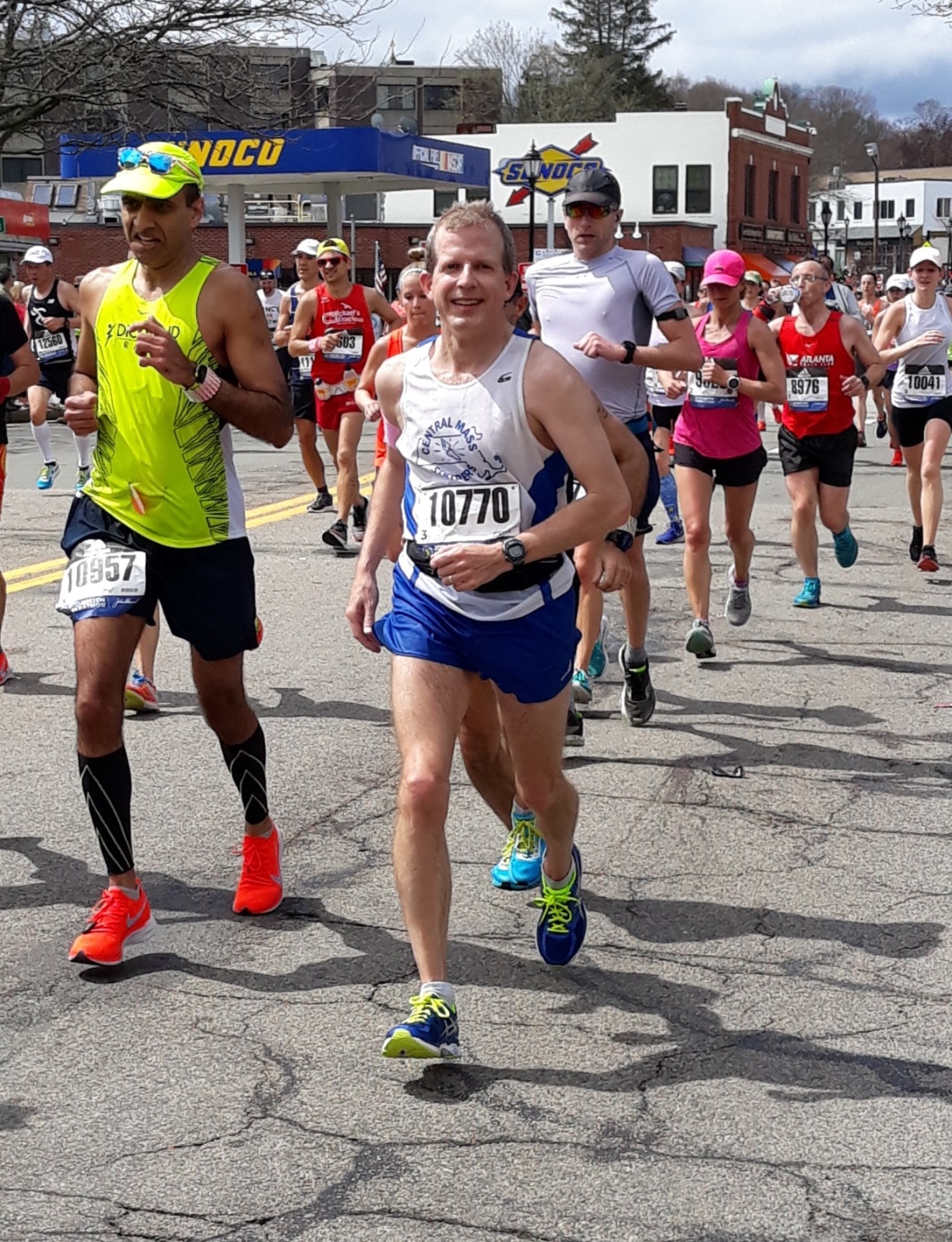
By Beacon Street it was Game Over. For only the second time in my thirteen Bostons, the other being the year I’d just had my foot surgically repaired, I got to the space of It Just Doesn’t Matter. I walked when I felt like it. So what? I smiled and waved and joked with encouraging spectators. Why not? I looked left and right and saw scenery I’d never noticed. Why’d it take me so long to do that? And when I got to the (brilliantly orchestrated) pedestrian crossings that my local Highland City Striders club was operating at miles twenty-three and twenty-four, I celebrated: high-fives all around at the first one, though I made a show of it and kept running, and full stop, hugs all around at the second. Once again, one of the best race pictures ever came about when I wasn’t actually running.
After one last walk on Hereford Street, I made sure I was running around that last fabled corner (way too many overpriced race photographers there to do otherwise) and settled in to jog it out. But in a last burst of pride, I noticed that a ten-minute increment was creeping closer on my watch, and, despite being in the ‘purely for the joy of it’ zone, that racing brain kicked back in and told me I’d be less than happy with myself if I let the clock tick over. One final burst down Boylston brought it home with seven seconds to spare – against a meaningless number of course, but hey…
Did I mention it got hot? I can count on one hand the number of times I’ve finished a marathon and not needed a heat sheet, though I took one anyway. Within hours it would be raining and cold and nasty windy again, but for the moment it was the tail end of the steam heat that had just generated the worst positive splits (positive is a bad thing, my non-marathoning friends…) in my recorded history, but gave me a walk to my ‘other local club’ – the Squannies party – without the usual shivering. Whatever.
As for Boston 2020, at the moment I am out. I’ve got another marathon planned in a few weeks and another chance to snag a qualifying time, but if the couple of weeks since the race are any indication, my chances, quite frankly, don’t look so good. My body is just not happy these days. There’s always the charity route, and though I loathe the idea of hitting up my friends, if I thought that this was a temporary thing and that a big recovery loomed, I might consider if for a year. Frankly, I don’t, so I probably won’t. And as I’ve stated earlier, if the streak ends here, it has been a hell of a ride, and I’m good with that.
Ironically, for my recovery week, Dearest Spouse and I headed to Seattle to visit Darling Offspring the Elder (hint: never fly out of Logan the Wednesday morning after the marathon), and during that trip, in between lots of amazing food and some very slow recovery runs around Capitol Hill and Volunteer Park, we paid a visit to Seattle’s Living Computer Museum. Besides a fabulous and warm-memory-evoking display of a Digital PDP-8, the machine on which I cut my teeth, which in a way led me into my college, which led to the literary gift from Bob, which led me to New England, yada yada, there was also one of the original Data General machines, the Nova (opening photo, above). That one pre-dated my time at the company, but that was the machine who’s successor, the Eclipse, was built by the team that coined the term ‘playing pinball’. Full circle.
Quasi-Appendix
Here’s a little explanation on qualifying for Boston, and how it’s different when you’ve got a ten-year streak going.
It’s well known that you must run a certain time in a qualifying marathon to gain entry to Boston, and that your qualifying time, or “BQ”, varies by gender and age. But owing to the popularity of the race, there are many more BQs than can be accommodated. To avoid the typical rush like what happens every time a block of tickets opens up for Hamilton on Broadway, the Boston Athletic Administration devised a creative and fair solution. Simplifying the story a bit, once everyone who wants entry has registered, they rank entrants by how far each is ahead of their own BQ, then fill the available slots from the top down, biggest gap of actual versus BQ wins. An old guy like me can get in if I’m five minutes ahead of my BQ, whereas a young guy who ran considerably faster than me still might not if he was only one minute ahead of his BQ. In the years since this system was devised, the gap, or the cut-off, needed to gain entry grew so much – this year it was close to five minutes – that the BAA just shifted the qualifying times down by five minutes across the board for next year. That just brought reality into the process for the typical applicant, but for us ten-year people who weren’t subject to the cut-off, we just found our qualifying standards tightened by five minutes, because there’s another piece to the puzzle. Once you’ve completed ten consecutive Bostons, you’re given the opportunity to register early and skip the cut-off. We ten-year folks can get in just by making it on the nose. This was a big advantage when the cut-off grew large. Now that the qualifying times have dropped across the board, our reality has caught up with everyone else – for now. Chances are good that even with the new standards, the cut-off will grow again.
07 April 2019
Train Wreck A’Comin’
It was a typical Thursday night evening club run, the kind we call ‘After Dark’ before Daylight Savings Time rolls around (gloriously), reduces our need for blinky lights, and turns them into ‘Into the Dusk’ runs. I consider these to be fun outings, three-quarters social and one-quarter workout. Though it’s true that if the right people show up, the run can morph from the a casual jog into sort of a quasi-fartlek, with the ‘fast gang’ pouring it on for stretches before circling back (amid shouts of “Swarm!”) to recoagulate the group. Never are they the kind of workout that makes you hurt the next day (summer hills and track arrived this week just to offer up that possibility).
But this time, by a couple miles in I was first skipping the out-and-back stretches up the bonus-hill cul-de-sacs, then limping alone back to our host’s home to nurse my woes in some of his home-brews among good friends, feeling sad, annoyed, conflicted, whatever. Boston was then just over two weeks away and I was out of commission. My right calf, which had twinged a bit on two earlier runs, had gone full-out pull, strain, tear, whatever; it just damn well hurt enough to tell me without a doubt that I was out for a least a few days. Having just hit a birthday the day before, that coming on the heels of my annual ‘return to running anniversary’ (fourteen years), and thus already feeling somewhat aged, then having had to deal with a plethora of other issues over the last few months, it was a good thing that home-brew was there (thanks, Mike) to prevent a Full-On Funk.
Let’s put it this way: lately it’s kind of like I’m standing on a low hill, staring out to sea, and I can see the tsunami coming. There’s not a lot I can do about it, not even run away, since running, it would seem, is one of the things I’m not doing so well at the moment. And now Boston is barely more than a week away. The train wreck, she is a’comin…
Over ten years ago I set out to write this blog with the theme of documenting the ups and downs of running later in life; ‘later' at the time I started writing loosely meant over forty, or in short, not a kid. The clock ticked, the bell tolled, and now I find myself documenting an entirely different kind of ‘later’, this one being what is unmistakably the start – or perhaps well into – the inevitable decline of aging. I’ve lamented many times in this column that it might be coming. I’m done with that ‘might’ stuff. It’s here. So let’s just deal with it. (And I’ve used way too many single quotes, so I’ll stop now.)
To begin with, I did something I rarely do. I went off for our weekend upstate New York visit to Dearest Offspring the Younger without a whit of running gear in my bags. No gear, can’t succumb in a weak moment and go out for a run, only to re-injure. Witness protection program. Forced healing, if you may. Nearly a week after the Calf Nelson, I finally gave it a test run, and yes, the calf came back, but by now it’s nearly certain I can’t save myself from the product of an entire season of bad training. Certainly not in a week before Boston. And certainly not with a knee that’s progressed pretty much beyond the point of no return.
Enough of that, at least for a few paragraphs. Look at the bright sides, right? That’s what I always try to do here. The bright side that my last race produced what I consider one of the best race photographs ever, so outstanding that I actually paid the photographer a few bucks to get a licensed copy to post it here without guilt. A photo that was so great because… I wasn’t racing. We’ll get back to that story later, but for now, just soak up the joy of me with the chowder ladies. You serve chowder (especially good chowder), I will come to your race. You insist that I take some home to Dearest Spouse, I will pose for a photograph. And no matter what happened on the course, I will leave happy.
Before we got to that chowderrific day in New Bedford (or New Beffuhd, as I often call it), I had to pass through the perennial rite of winter, the Hyannis Marathon Relay. Back in my college days, my service fraternity used to get a chapter award every year from the national organization, since all you really had to do to get it was to fill out the application which showed that your chapter was not, in fact, dead, and that you had, in fact, performed some service. And like magic, your H. Roe Bartle Award would arrive, the award you got for asking. Hyannis has almost become that: if you show up, show that you’ve made an effort to run a decent pace (e.g., you are not dead and you have performed some running), you will win your division in the relay. Which we did, for the ninth time. I need a bigger shelf for the clamshells.
Actually, two funny things happened this year, besides yet another year of dismal cold, rainy, and windy weather. First was that we actually did have some competition, and while our team’s time was off from previous years and was still enough to win our ninth masters’ division clam shell, there was actually a team within ten minutes of us. Second was that we weren’t really masters. We sort of screwed up. To qualify as a masters team, everyone has to be over forty. We were all, as it turned out, over fifty, which meant that while we were perfectly legal to race as masters, we should have raced as seniors so as to avoid the withering competition of the young’uns. Oops. No matter, we ran off with it anyway. And a good time was had by all, as usual, except for the fact that they did not, as they usually do, have chowder after the race. Boo. Hiss.
The chowder had to wait for the New Beffuhd Half Marathon a few weeks later. Unlike Hyannis, New Beffuhd came around with the finest weather I’ve ever seen at that beloved race – so fine, in fact, that the legendary wind late in the race was for once almost non-existent. Despite this, it was a somewhat miserable day. How? Let me count the ways.
I should note that I actually ran a pretty good eight mile race. The only trouble is that this was a half marathon. The wheels started coming off at eight and things got progressively uglier as the miles clicked by. I was hoping that nobody captured me on film (er, pixels) late in the race, but sadly someone did ensconce for eternity my complete collapse of form, dignity, and hope.
Those high miles were the culmination of a myriad of woes, some previously documented here, some held in the deepest folds of darkness. You’re tired of hearing about the knee. You’re not surprised when I tell you the other one hurts at times, too. You haven’t heard me complain that my back has been acting up for months, on and off, but it has. And you won’t be surprised when I tell you that a week back (this has nothing to do with New Beffuhd), a strange sharp shooting pain attacked my right upper pelvic bone while on a short run over to the gym. So sharp it stopped me cold. So strange that the best Dr. Google could suggest was that I needed to have my uterus removed, which I think would be a significant challenge for the medical community. And stranger, the next day it was gone, completely, nary a wisp of recollection, never to return.
But the thing that’s making me feel old is that a few months ago Lady Doctor read me the scroll of reality. Those nagging cholesterol and blood pressure threats that we’ve been ignoring on the theory that enough exercise heals all wounds, well, as one’s age advances they grow on the risk charts, and the time had come, she said, that we had to do something about them. Exercise alone wouldn’t absolve her medical concern; it was time for low-dose meds. And though she hand-picked solutions described in the medical literature as ‘exercise tolerant’, within weeks of introduction I was a slobbering hopeless mess. Well, perhaps not slobbering, but all remnants of performance pretty much went to hell rapidly. Backing off on them helped a little, but it just seems that some damage of age has been induced.
And that was going through my head, if not my veins, while I plugged up the final hill at mile twelve, looking so obviously ragged that runners passing me were shouting the kind of encouragement that you toss at the hapless. Bless them. They meant well.
Perspective time: I’m battling age and wear and tear. It’s nothing compared to my friend Tom who’s battling cancer. And while this ended up as a Personal Worst for me in the half marathon, somehow I still almost scored for my team, rolling in less than a minute out of the money. And let’s face it, no matter how slow I thought it was, few of my non-running friends would find it at all understandable to hear me complain about how long it took to run a half-marathon, since that’s something they just don’t even consider doing on any given random weekend. Yeah, things hurt. But they do for most people my age. Deal with it.
So Boston looms, I’m more or less permanently injured, and I’ve run only a few more miles in the entire first quarter of this year than I have in some months. Whatever.
The reality is that all I have to do is finish Boston to keep my thirteen-year streak alive. Re-qualifying is the goal, and in any other year that wouldn’t be too hard. But if I don’t re-qualify, I’ve got a backup race already planned a month out. I’m hoping to make that just a fun outing with my clubmates, but it can turn deadly serious if it must. And if that fails?
Again, perspective time. When I started this whole Second Lap adventure, running a marathon wasn’t the goal, the plan, or even on the recipe list. When finishing a marathon turned into marathoning (my definition of having done more than one), qualifying for Boston wasn’t a realistic prospect. Surprise. That happened. Then it happened again. And lather, rinse, repeat, it kept happening. But it’s not going to keep happening forever. And it’s extremely unlikely that it will happen long enough to nudge myself onto that famed page in the Boston Marathon program listing the longest streakers. Heck, to make twenty-five, I’d need to keep this up every year till I’m sixty-eight; not saying I don’t want to be running then, but still chunking out Boston every year? Unlikely.
So it’s going to end, and when it does I will walk away, head high, smile on my face, and say, stealing the Douglass Adams line, “Thanks for all the fish.” There’s no point in lamenting. I never saw this coming (well, OK, I did dream, whatever), it came, and it’s been a helluva’ ride. And besides, there’s plenty of fun on our casual group runs and there are plenty of other adventures to tackle.
So let’s go see if this turns into a train wreck. Oughta’ be fun, in its sick sort of way.
08 February 2019
A Tale of Two Cities
It was the best of times, it was the worst of times…
I’d be lying if I told you I’d read the book, but everyone knows the opening lines. And it only takes a few seconds to Google the classic work and learn that the two cities in question were London and Paris, and that Dickens wrote of those places at a time of great disruption, that being the French Revolution, plus or minus a few years, and how conditions impacted the lives of those who made their way through those places and times.
I, on the other hand, am simply stealing his well-known title to make a point of how civic conditions, and I would posit the leadership decisions that brought them about, make a difference in the lives and experiences of both residents and visitors to, in this case, two cities, these being domestic and thus a little closer to home, but rivals in a sense not unlike London and Paris. And yes, you could say we are also living in a time of great disruption, since my transit to and from the second visit in this pair was anything but certain in the face of our governmental disfunction thanks to the antics of a certain highly despised authoritarian figurehead and his similarly highly despised tortoise-like legislative crony. But this is no place for politics. Even if it had to be said. And I’ll be happy to go on. But I won’t.
Austin and Dallas. A hipster town and the Big D. Texas rivals, of a sort, though I suspect that Austin sort of shrugs its shoulders at Dallas, while Dallas makes a big point of being that Big D. But I don’t judge a city on its size and might. Rather, I judge on livability, which for me, as you might guess often comes down to runability. If a town makes the effort to create places where you can get out and get some fresh air, it seems to me that that town is thinking in the right direction. And that town is a lot more pleasant to visit.
I used to travel to Texas regularly, but till a few weeks back it’d been quite a while since last I set foot in its broad expanses. I’ve now made two trips in the last two months, one to each of the aforementioned municipalities. I made the effort – as I almost always to – to get my runs in while in each of these venues. And how do they compare? Well, my verdict was easy to reach: Dallas wants to be known as the Big D, and I’ll agree; it earned its Big D, while Austin lived up to the irony that its name begins with an A, as it easily earned that grade.
If I was blessed with bazillions of readers I’m sure there would be denizens of Dallas who would protest. Fortunately, with my blog’s miniscule eyeball count, the likelihood of anyone from that locale reading this is low. But even if they see this, I’ll stick by my story, despite my assessment not being terribly thorough or scientific, or by any means above reproach on other dimensions.
First, let’s cover off all the holes in the logic of my judgement. On my trek to Dallas, I never made it more than five miles outside of the perimeter of Dallas-Ft. Worth Airport. Bedded down in Irving, literally in view of the vast open space that is DFW, and working in Coppell, I never made it into Dallas proper. Had I made it downtown, I’m told that Dallas does have a trail, albeit paved most of the way, known as the Katy Trail, that heads more or less from downtown out toward Southern Methodist University and the White Rock area. I’ve been to White Rock and it’s reasonably pleasant, with some walking paths around the lake and some interesting birds to notch on your life list, if you’ve got one. It even hosts Dallas’ marathon.
But nine times out of ten, when you go to Dallas, you don’t go downtown or anywhere near those places. In all of those trips to Dallas over all of those years (and there used to be lots, I’d say I’ve been there at least twenty times), I ended up staying downtown exactly once. Sadly, the typical Dallas excursion places you in the endless pave-the-next-county sprawl of places like Richardson and Plano, where everything is made of the exact same shade of beige concrete. Cut-and-paste society, a colleague of mine once called it as we travelled around looking for dinner one night. Everything pretty much repeats every three to five miles.
On my last trip, I tried striking out north from my hotel, away from the airport, into Coppell. In the span of a six mile loop I crossed two freeways twice, scrambled through massive intersections designed with no recognition that pedestrians exist, and alternated between the leg-crushing (beige) concrete and trying to run on the artificially-installed turf strips along the road that have a uniquely hard and lumpy surface that is entirely non-trail-like and nearly impossible to stride over. But that was where there were places to run. Dallas has no qualms about narrowing a four-lane arterial (and they’re all four, or six, or eight lane arterials) to two narrow lanes lined with barrels over a bridge and – of course – no pedestrian space. At times like that, I had to take my life into my hands, because I really didn’t know the area well enough to pull off an ad-lib detour. In calmer moments, it was still a drunken wander, since in many cases where sidewalks do exist, they were infected with the New Jersey Wandering Disease.
Huh? The New Jersey Wandering Disease? Yeah, so named because that’s where I encountered it first. It’s when suburban sprawl road designers think it’s cute to make the sidewalks squiggle all over creation because, after all, those sinuous bends look good on real estate brochures, and they figure nobody is going to walk on them, and if they did, they’ve got no place to go anyway. Hey folks, I’m going for a run, not to a theme park.
After that first disastrous outing, I headed the opposite direction for the next two mornings, where the sidewalk (which you have to use because that route was another four-lane shoulder-less arterial, even though it was brand new and there was barely a car on it) rose up a bank, became ten feet wide, and, you guessed it, went all New Jersey on me. I guess you need something to break the monotony when otherwise all you’d see is the massive mile-long wall built to shelter the residents of the latest McMansion development from that riff-raff of (horror!) the road. Oh yeah, did I mention it was beige?
Get me the hell out of Dodge, please.
But this past trip was to Austin. I’d been to Austin only once before, so many years ago that I don’t even think I was running then. Back then I went to Austin both on a history tour, as I was reading through Robert Caro’s brilliant biography series on Lyndon Johnson (which was intended to be a trilogy, but he’s now working on the fifth book – I like people who operate that way – and I highly recommend all of his work), and because I was so sick of going to Dallas that I needed something different. My recollection of that trip was good, but vague.
Cut to this past excursion, when I was camped in a “luxury” (read: overpriced) hotel downtown to be near the convention center since this was, in fact, for a convention. Downtown anything Midwest can be, like Dallas, a flat concrete jungle. But Austin is blessed with two things: first, a river that runs through it (or, since it’s dammed, they call it a lake), and second, and I’m guessing on this here because I know it takes positive action to make this happen, the civic leadership to espouse such a jewel and develop it for the betterment of the community.
Because of this, Austin doesn’t have the character of a concrete jungle. Now, I’m sure that when one goes away from the center city, there are concrete jungle zones. I certainly saw the size of their freeways heading from and to the airport. But I also saw on the maps that there are quite a few green spaces even away from the city center, and many of them appear to connect.
The part I do know about, after nearly a week ‘in country’, is the trail network around the Colorado River (a.k.a. Lady Bird Lake), and up Barton Creek past Barton Springs. Trails encircle the lake, extending five or six miles end-to-end, punctuated by dedicated pedestrian crossings, some glommed onto automotive bridges and one dedicated entirely to human-powered travelers (ignoring for the moment the ubiquitous electric scooters that litter the sidewalks and add a little sport to pedestrian navigation). These trails occasionally coincide with parallel streets’ sidewalks, but mostly traverse the riversides on dirt and gravel, often through shaded arbors, and in a couple of places on boardwalks (well, false flagstone walks) on bridges over edges of the river, er, I mean lake. By mixing up the bridge crossings, I was able to create a healthy combination of loops.
Then there’s the Barton Creek trail, which I explored on a run with a co-worker from Canada also in town for the conference. Extending southwest, this trail first leads up to the city’s swimmin’ hole, at which point you do have to hit some pavement to get around. But on our first foray we missed the spot where the trail heads away from the creek and found ourselves at an odd dead-end, staring at a dam, a concrete wall, and a fence. Before I had a chance to turn back to find our error, my daredevil companion had shinnied out on the pipe while clinging to the fence and swung himself around the wall onto the other side, which turned out to be the swimming area. I had no choice to follow, though my acrobatics were considerably slower and more cautiously executed. (Easing back into a run along the shore, we were duly chastised by the lifeguard about the ‘no running’ rule. Lifeguard? Swimmin’ hole? January? Right, southern Texas.)
Beyond there, the trail turns rough, rocky, and technical as it skirts small waterfalls, white water, and calm basins. It’s not exactly green, this being a fairly arid climate and it being January, but it feels green enough, and it’s just, well, lovely to be in this space within running distance of the skyscrapers of a major city. An eight mile out-and-back from the hotel got us well into this bit of quasi-wild canyon – which extends much further – which is at times rimmed with civilization atop its walls but is all rocks and trees and water down below.
And the people. These trails are full of people. This system is the life of the town. I spoke with numerous people who told me they’re out there every day. Runners, walkers, dog people, you name it. It’s healthy, it’s community, and it’s a damn fine cure for when you stay out way too late in Austin’s famed music scene. Yeah, I took one for the team, so to speak, and put in one of those ‘I don’t do this very often but yeah, that was awesome’ nights at Pete’s Piano Bar, soaking up the amazing raw talent of the musicians and slicing several serviceable years off my vocal chords despite trying to soothe them with copious amber fluids. Oh, and there was that now infamous ‘wall of donuts’ at the convention closing party. Yeah, the trails are good for that, too. One last sunrise run before heading to the airport made even that fifteen-and-a-half-hour odyssey getting home entirely bearable.
Austin feels more Oregon than Texas. The river (er, lake) and its trails define it. The community forms around it. It sets a tone that extends well away from the river. And if I had a chance to select the location for a future meeting, it would draw me back.
It was the best of times.
19 January 2019
Double and Nothing
I’m at the age when things are supposed to start to slow down. Retirement (oh my, that word!) is within a ten-year window, hopefully sooner, and life’s priorities should be shifting toward enjoying things in the twenty-or-so years before bodily functions slow down (far more than they already appreciably have) to a point where some things become considerably impractical. So how come two months have passed since I’ve had the time to take a breath and pound out some storytelling? The busy level of late has been rather frenetic, but today I have a block of brilliantly uninterrupted time – since I’m not connected to the Internet – yes, airplane time. Clatter away, keys, clatter away.
To be fair, part of the issue is that there are fewer stories to tell. I’m racing less and spending more time managing a knee that almost certainly will never truly get better, and you, dear reader, get rather bored with prose about yesterday’s training run. But I haven’t been devoid of stories altogether, and yet still, my production schedule lags.
I missed altogether relating stories from this year’s instance of the Mill Cities Relay, but to be fair (again, do you see a pattern here?), there were fewer stories than usual from that soggy outing. Our team found itself separated at birth due to various participants’ weekend time conflicts, meaning we never were all in the same place at once, somewhat diminishing the team fun aspect of the day. The weather was ugly as it is wont to be in early December, and though the steady rain magically slowed a minute before the start of my opening leg, it paid me back after our third-leg man wanted to run a warm-down and I, nearly dry after playing team driver for the last two legs, foolishly agreed. The skies opened and we re-drenched ourselves, thus arriving waterlogged and shivering at the bash at the finish line, but still had a fine time. No brick (top placing teams at Mill Cities are awarded bricks – really), but that was to be expected.
Oh, and that opening leg I ran? Well, it rolled in faster than I expected, but considerably slower than last year. Which takes us back to that, ‘things are supposed to slow down’ bit. And they have. I vacillate between thinking I’ve gotten way slower (which I have) and that I’ll get whomped any time I show my face at any moderately competitive race, and alternately deeming I’m really not that out of it, scanning the race articles in the back of New England Runner and seeing that the senior division times are still often in line with my reality. I know I should just go ahead and race anyway, and to be fair, I’ve got four and a half future races already in the chute, so that will come. In the meanwhile, it’s fun to just kick back, enjoy the sport for what it is, and take part in some activities that don’t require speed, pain, and suffering.
Like running two marathons two days apart.
I haven’t told many of my non-running friends about this one. The few to whom I’ve mentioned it are certain I’m overdue for the looney bin. My running friends, on the other hand, know of goofy things like the seven-day, seven-continent, seven-marathon challenge, and see just doing two as relatively tame. Well, some of them, at least. Other of my buds often run ultras, where twenty-six miles is just the warm-up. For them I just said that I ran a fifty-two miler over a span of forty-nine hours. Even at the ‘go slow and survive forever’ pace of an ultra, that’s absurdly leisurely.
The end of the year offers an interesting opportunity for this kind of lark. The last Sunday of the year plays host to the Groton Marathon, a loose conglomeration of crazies from the Squannacook River Runners, where participants are welcome to run anywhere from a couple of miles to the whole banana. And New Year’s morning brings another tradition, the New Year’s Boston Marathon, where a different loose conglomeration of total loonies, goaded on from afar by the Maine’s somewhat legendary Gary Allen, gathers at six in the morning in Hopkinton on New Year’s Day – an hour when some have yet to go to bed from the previous night’s revelry – and proceeds to hoof it into Boston. Depending on the vagaries of the calendar, these two runs fall anywhere from a week to a day apart.
A few years back, I did the double, though that year granted the reprieve of a six-day separation between the two. Last year, on the other hand, the calendar decreed a back-to-back, Sunday-Monday combo. The allure of that stunt had me mentally booked in for weeks beforehand, but last winter’s deep freeze forced a level of sanity. Groton that year went off at one whole degree (that’s Fahrenheit, for my one likely Canadian reader), though under a warming sun. But the next morning called for minus four at oh-six-hundred, and with no sun to temper the chill for at least an hour, I flat out chickened out. So this year I’d have to settle for the two day span, Sunday and Tuesday, but I figured it still qualified for mildly wacko.
To those who insisted that one must be certifiable to even think about doing this, I could constantly explain that these weren’t really like running marathons but were instead more like running very casually for five miles or so, stopping for goodies and chit-chat, running another five till another stop, and so-on. Not what I think of as a marathon where I’m typically pushing from start to finish, only stopping if forced to do so, and utterly spent by the end. That explanation certainly didn’t work well for my non-running friends, and didn’t even work well for many of my running friends for whom a marathon is just that – a few miles, a break, a few miles… Yeah, I know. Just go with me on this; these weren’t killers.
Groton kicked off a big twenty-six degrees warmer than last year’s edition, with about twenty starters posing amidst the pile of cut trees and construction debris that kept us just short of our traditional start point (fear not, we doubled back a tad at the end to ensure the full distance!). That count would dwindle to nine who covered the full route – but that was a record by a factor of two for the now six-year-old event and included our first vision-impaired runner and our first female, who, in the spirit of Jock Semple, we offered to bowl off the course about six miles in (oddly, she declined).
The Squannies as usual provided terrific support with goodies at the stops (like this one at mile seventeen amidst the delightful sunshine), any and all needed logistics, and even companion runners for those flagging a bit. And of course, at the end they supplied their classic Sharpie-labelled Christmas ball ‘medals’ which in their bulbous form don’t easily fit on any medal rack (yes, after nearly fourteen years of racing, I finally got a medal rack – thanks, HCS Dave! – and instantly filled it beyond capacity with another equivalent collection to spare). We constantly goaded each other to slow down, stick together, save our energy though the first twenty miles before letting ourselves open it up a bit at that point. From twenty-three, my cranky knee was, like last year, insisting that I pick it up to reduce the stress that the slow pace seems to induce, but unlike last year, fortunately one other participant was of same mind, so when we dropped the hammer a bit and finished it, we were able to insist that we’d tied for second, since there really should be no winner of this event.
Monday, I rested. I’m crazy, but not entirely stupid. Besides, six in the morning is early.
New Year’s Eve wasn’t pretty if you were a Times Square or downtown Boston reveler. But the rains quit somewhere around five, and other than a few leftover spits, six arrived with wet roads but reasonably warm temps and a benevolent western zephyr that, while rarely actually felt, certainly must have offered a boost on our trek to the Back Bay.
Unlike Groton, this one isn’t really organized as a stick-together-group run – it’s show and go and figure out who’s there to run your pace on the fly. I vocalized my intended comfortable but faster than ambling pace, and two youngsters seemed to imply they’d be in that neighborhood, but when we set off at that raw hour (watch us goofballs go here), they were gone in a flash. I’d later learn they nearly broke three hours that morning. Instead I found myself in the company of two quite reasonably paced companions, one who intended only to run the first ten miles back to her home town of Natick, and another young lad who’d notched a few ultras but never a road marathon.
Call me a sap but I truly love the instant camaraderie that springs from being randomly coupled with a bunch of like-minded and like-paced runners. Though one of my companions lived a mere two towns away, I didn’t know her from a hole in the wall (though later, at the Natick Goodie Stop, an old runner friend would drive by, recognize me, tell me he knew her, and I’d realize we were only One Kevin Bacon Degree of Separation apart), and the other young lad was equally, if not moreso a stranger. No matter. By Ashland we were chatting it up and enjoying the ride.
Though this is a casual event, like Groton, there is enough organization behind it that our ‘race director’ for the day, Walter (of Mile10Connections), set up a full-fledged aid station in Natick, and later at the finish line. Amy left us in Natick, and Rob got a head start while I continued to jaw it up, so when I hit the road again, I had to add a little oomph to reel him back in so as to continue giving him the verbal tour of the course. After another aid station set up by his folks in Wellesley, I dragged him into the hills as he started to flag, his hips unhappy with the extended asphalt mileage.
By Boston College it was apparent he needed to tone it down, and it was apparent, thanks again to That Damn Knee, that I needed to turn it up. Knowing that his dad was leapfrogging to ensure his upkeep, I split off at the graveyard and, like at Groton two days earlier, turned on the jets. Beacon Street wasn’t exactly fast, but it felt fast, it felt strong, it felt downright fun to power past people on the street knowing they had no inkling where I’d started, and it felt seriously satisfying to confirm that at a marathon plus twenty miles into the next one, there was plenty of gas in the tanks to run this thing in for real. After all, a big reason for doing this was to convince myself yet again that marathons were still in my grasp if not merely in my blood, and that my joints, while possibly not thrilled at the prospect, were more than up to the task. And while neither of these would have re-qualified me for the next Boston Block Party, the running time (exclusive of those goodie stops) for each wasn’t far off the mark.
Best of all, the end turned into a bit of a party – just like Boston should be. Walter not only laid out a delightful spread (with help from a friend of his who owns and runs Pancho’s Taqueria in Dedham, who supplied fabulous homemade salsa, shameless plug!), but he being of the Boston EMS Heroes (yes, he was there on that fateful day in 2013) called out one of his on-duty squads who parked their unit at the finish line, lights flashing. Nothing beats cranking down Boylston Street – in (light but very much real) traffic – because, well, dammit, you’re finishing the Boston Marathon, and they can just go around you, and there’s an ambulance up there making it an event just to prove it. And just under forty-nine hours since we ambled away from the Groton Senior Center, I had two marathons – not the kind that count in my race list, but two marathons nonetheless – in my pocket.
At the finish I learned that the two youngsters had raced in and already left, but I hung for over an hour in the unbelievably warm fifty-degree-plus glory of New Year’s Day (consider that the weather was far better that on Monsoon Marathon Monday!), welcoming Rob and myriads of other runners who’d run various portions of the course (none that did the whole thing, at least that we met), including some I knew from previous adventures, before Walter graciously delivered me back to Hopkinton.
What a way to start the year!
So there’s the double part of the title of this episode, but what of the nothing? Usually it’s double or nothing, but in this case, it was double and nothing. After the double marathon and a few more days of easy runs, I had to admit that my body did complain a bit – mostly foot strain, toe bruises (almost all from the second marathon, guessing that my form was breaking down a bit in the late miles), foot cramps, and so on – and I was more or less forced to take a few days of nothing and lie low. The nothing part.
A small price to pay for some big smiles to remember some big miles.
Subscribe to:
Posts (Atom)