24 September 2013

Recovery

Based on reactions I’ve heard since my adventures in the land of pulmonary embolisms, or PEs, healthy fit people apparently do not qualify for death. Besides obvious (and appreciated) concern, comments have ranged from mild surprise to outright shock. How could that be? You? The guy who runs marathons? News flash: I will die, Usain Bolt will die, and much to the dismay of Darling Daughter the Younger, his biggest fan, even Ryan Hall will die. We will all die, even us runners. We’re not immune. But we do like to think it might be just a little bit harder to knock us off.

With a last name that starts with the word cat, I should still have the majority of my nine lives left, though I can reasonably say that I used one up on this round. A seemingly scholarly source pegs the mortality rate of a PE around thirty percent if left untreated (Wiki hints that may be a bit high), but that same article states the figure drops to single digits with timely treatment. Ah, timely treatment, indeed. I am reminded of how I elected to gut out the pain overnight because, well, we marathoners do pain (really, there was more reason to it than that), and besides, I could find relief by sitting up. Further, I commented last week on how being a runner – with the accompanying well-developed lungs – effectively eliminated the number one PE symptom, shortness of breath. This raises the interesting possibility that being a runner, and thus masking the malady, may have actually raised the risk by delaying treatment. But I’d rather believe that the mortality risk comes largely from that same reduced lung capacity I didn’t suffer, and therefore I’ll credit running for saving me… again. Certainly fitness makes bouncing back easier. (Of course, we’ll politely ignore the fact that running got me into this mess to begin with.)

Many have asked about treatment, progress, and prognosis. You all know that I’m generally liberal with my HIPAA rights and gleefully publish any and all pictures of my innards, but I’m often vague and intentionally comical with details, not for fear of privacy, but simply for fear of boring you to a state where you too need medical attention. But in light of several requests, I’ll spell out some specifics in uncharacteristically chronological and detailed form.

Once we’d identified the source of my special agony, treatment was immediate. Since I wasn’t in any form of arrest, invasive or other emergency measures weren’t needed, but I was put on an intravenous anticoagulant, heparin. This, along with the other medications that joined the chem-fest, and which I lightly referred to last week as Drano are often called blood thinners, but they really don’t have any impact on the viscosity of your blood. They simply act on the proteins that cause your blood to clot. There are, I am told, powerful clot-busters available, but fortunately, I didn’t have to go there. Again, no critical arrest situation, so our goal was to let my body break up the clots that were already there, which will happen over a few days, and assure that no new ones formed and took up residence.

It’s worth pointing out a little human geography here. There’s a reason you studied this in high school biology. You just didn’t know that you’d care about it some day. Recall that your heart has four chambers; it’s really a set of two pumps, each with two chambers. One side takes the blood returning from your body via your veins and sends it to your lungs to pick up oxygen. The other takes the blood from your lungs and sends it back to your body via your arteries. The bad news is that a clot that forms in your body, notably in your legs, and breaks loose, will most likely pass through your heart and get filtered – and stuck – in your lungs. Bam! PE! The good news is that those clots will get filtered – and stuck – in your lungs, because they’re a whole lot worse if they make it to your brain. If a PE is no fun, a stroke is downright evil. (Clots that cause strokes originate elsewhere, such as in the heart itself, if certain defects exist that cause blood to pool where it shouldn’t.)

Thus it was my clot filter, alias my lungs, that held my collection of special plug friends, and there was really no way to say that more might not be on the way, departing the dry-docks where they were built in the shipyard of my leg, ready to set sail and land in the filtering marshlands of my lungs. That, and the fact that I was on a drip, made it a really good reason to hang out and eat hospital food for a couple of days. Hey, it wasn’t gourmet, but it really wasn’t that bad, either.

Treatment isn’t short-term, however. Protocol says you stay on anticoagulants for life it you’re prone to this problem, or for a period that was quoted to me as three months, six months, or even a year (depending on who we asked and what the current wind speed was) when the problem arises from a known event like mine, post-surgical. This means transferring to an oral med, and an extremely common one at that. If you don’t know someone who’s on Coumadin, alias warfarin, alias rat poison (really, it is the same stuff, though the rats are becoming immune to it so it’s not used so much anymore), then you’re either cloistered, clueless, lucky, or twelve. In short, this isn’t at all unusual. You just don’t hear about it much amongst runners.

Warfarin is a funny thing, though. It fiddles with the enzymes that cause clotting, but it first bumps up the ones that cause you to clot more before it gets around to bumping up the ones that make you clot less. So you have to stay on something else until it takes effect. The stuff in the drip, heparin, is, like warfarin, so dirt cheap that you could fill a bucket with it and have change left over from your five dollar bill, but it comes with a thousand-dollar-a-day delivery charge, that being, a hospital bed. The alternative, enoxaparin, alias Lovenox, costs a bundle, but you can sweet talk your Dearest Spouse into shooting you up with it at home. OK, full disclosure, I’m a needle wimp and really wasn’t keen on that idea. It’s far more accurate to say she sweet-talked me into it, and I nervously giggled in defensive angst the next few days while she deftly operated the syringe.

All of this less-clot stuff translates to a simple more-bleed, which tends to make you rather tense, especially in the first few days when you just don’t know what to expect. After all, I’d never seen a medication that literally stated in its user warnings, “Do not pick your nose.” Seriously, it really says that. But it’s more than a week later, and I haven’t bled out yet (though one of those injections left a nasty bruise, so clearly bleeding does happen), so things are hopeful. They haven’t kicked me out of the kitchen, but working as the executioner on the guillotine platform during the French Revolution is probably right out.

We’re still working on getting the dosage right through cycles of adjust, test blood, lather, rinse, and repeat. Yesterday, my number spiked, making me put an extra few feet between myself and the guillotine while we turned down the rat poison a bit. But at least that means no new clots. It’ll take a while to work this out. But other than that, if I don’t slice my finger open, fall down, or get in a car wreck, I really can’t tell I’m on anything. And I’m told this will in no way prevent my return to training, when the Achilles is ready. I’m feeling good, the progress is good, and the prognosis is good. Again, just don’t fall down.

With that in mind, this past weekend was designated as “Return to the World of the Living”. Freed from crutches, hobbling a bit more gracefully in the walking cast, I returned to the gym not only for some lifting (arms hurt, ah, good pain!), but for forty minutes on the recumbent stationary bike (butt hurts, ah, good pain!). Happily, the motion put zero strain on the Achilles, and I was able to put in my first aerobic work since the slice, followed by another round today. Thankfully, the poundage has remained stable despite this sedentary life coupled with continued consumption.

Sunday also brought one of our local favorites, the Forrest road race. Of course I couldn’t run it, and though I thought of walking it, brains overcame yearnings, and rather than risk damaging this repair for which I’ve paid so mightily, I instead stayed relatively still and directed traffic in my clunky cast, both to assuage my guilt for crashing the picnic afterward and to feel like I was back in the running world. Nobody else seemed to think that the volunteer work payment-in-kind was needed, but it made the beer taste better. Mostly, it was just great to be back with my peoples.

And yesterday marked a month since the slice. It’s healing nicely on the outside, if still somewhat tender on the inside. My fingers – and toes – are still crossed, hoping this works.

13 September 2013

Out Of Left Field

I’m a certified National Public Radio addict, but in the morning, the clock radios that line our bed are tuned to a commercial station that caters to – oh, it’s tough to say this – our somewhat (but not very much) older generation.  Not being the morning variety person, rarely am I awake when mine comes on, let alone when Dearest Spouse’s pierces the pre-dawn darkness much earlier.  Yesterday morning though, I was indeed awake at that moment (we’ll get to why that was true later), and the instant the sound hit the room happened to be the instant of a truck commercial timed such that the first thing we both heard was “GMC”, which for the past fifty years has in fact been my initials (with due amusements that at times accompany that little irony).  Waking up to the Gods of the Airwaves greeting me by name might imply that this was going to be my day.  Nothing of the sort was remotely true.

Just two posts ago I opined on the topic of whether the ordeal of the Achilles surgery, and more to the point, the ordeals of all the things runners have to cope with as a result of their habit, were worth the cost.  I said then that the reward far outweighed the cost.  Despite what I’ve been through in the last few days, I’ll stick to that.  But wow, what a few days!

This week’s promise was to have been the start of my migration out of the splint and into the boot, most importantly off the crutches.  But like a bolt out of left field, a freight train showed up and derailed that plan.  Rather than hobbling around the house in the boot, I’m lying in a hospital bed getting pumped full of Drano and enjoying a fresh round of painkillers.

Say what, say you?

Let’s back up a bit, because by the time of waking to a public acknowledgement of my monogram on the radio, I already knew it wasn’t my day.  Twenty-four hours earlier I’d awoken in moderate agony.  I didn’t know it was merely moderate until I found true agony later that day, which gave me a better yardstick on which to measure such joy.  The source of said agony wasn’t at all clear, but had I guessed my fate at that moment, the word kidney would have been involved.  Stories I’d heard of how kidney stones felt like childbirth came to mind, but popping a pill and moving around a bit brought enough relief to believe there was a chance it was a fluke, if not a seriously ugly fluke, and that it was worth riding out.  Most of the day, spent at my desk, passed with only mild aftereffects.

But that evening it was back, this time multiplied by two, with my shoulder now joining my kidney at first simply screaming, then expanding the scream exponentially to a veritable riot when I laid out on the couch for relief.  No amount of Googling of “pain kidney shoulder” turned up anything rational or remotely plausible.  Kidney and shoulder?  One’s an organ, one’s a joint.  Made no sense, but at least this time I figured out that staying upright made it (mostly) go away, which in my  logic of the moment, hinted I didn’t need to race to the emergency room.

But it was a rough night, which led to being wide awake when that radio sprung to life saying, “GMC!”  Call it the ultimate wake-up call, I suppose, because by this point it was clear this wasn’t a ride-it-out scenario.  The only question was what to do first.  I often say that you will have no way of knowing what the thing that finally kills you feels like, since you will, by definition, never have felt it before.  Likewise here.  This seemed pretty serious, but was it emergency-room-worthy in an era where everyone tells you that the ER is the most costly way to deliver medicine, and that you should use your primary care first?  Still in the mode where sitting upright made it bearable, I opted for the economically advantageous choice, and headed for the office of Lady Doc.

Lady Doc, one of our heroes from blogs past, somehow carved a huge amount of time from what I presume was already a booked slate.  Together we carefully covered as many bases as we could collectively think of, leading us through an odyssey of tests ranging from easy to successively harder questions.  Pass the last one, you get an A.  So who was the criminal element in this puzzle?    To little fanfare, the theory of a bizarre nerve pinch left over from my lifting at the gym a few days back wasn’t realistically pursued.  To my expectation, despite the oft-cited ‘pain-in-the-shoulder-means-you’re-having-a-heart-attack’, my ticker was preliminarily cleared (to be subsequently further cleared not only of blame, but collateral damage as well with another rollicking session on the echocardiogram with Tina the Tech of “Eighteen Again” fame;  great to see you again, Tina!).  To my surprise, the kidney was cleared; a great relief as I’d left the house half expecting to end up the target of stone-busting shock waves and the other half expecting to come home a kidney down.

Those discounted, that left a worrisome yet not unexpected, and altogether manageable scenario:  a post-surgical blot clot, formally known in med-speak as an embolism, and in particular, based on the source of my agony, lung-based, or a pulmonary embolism.  One more test, slide me into the CT scanner (another ten minutes of agony as was any time spent horizontally), and the verdict was rendered:  Dude, you’re not going home tonight.

Cutting to the car crash, the final score wasn’t an embolism, but a cross country team of embolisms, the top runner being of considerable girth yet interestingly located on my pain-free side, entirely innocent of agony of the day.  A collection of others joined in the fun – apparently it’s fairly common that when one is born, others follow, and they scattered themselves through the filter of my pulmonary arteries – but all had lodged themselves in places which still allowed blood to bypass.  All but one.  If not for that last one, I might have never known about this garden party, which might have been serene oblivion, or might have been fatal.  Kind of hard to tell.  But one of those buggers placed himself (I know it was a he, I just know it) down in the bottom back left corner – yes, right near the kidney – and effectively sealed off a very small bit-o-lung.  That sole cubic centimeter took one for the team and sadly has likely been given a game misconduct, but in the process it largely created the agony entirely disproportionate to its size.  Or so we think.  One can never really be certain.

The science that eventually figured all this out is, as usual, quite intriguing.  In the end, it was the CT scan, a technology that’s been around for quite a while, that found the smoking gun.  While it uses different energy than an MRI (unfortunately with much more radiation, but it’s the price you pay), the basic idea is the same:  take successive slice images of using frequencies that can discern different types of soft tissue.  What was different from the MRI was that, perhaps due to the higher radiation, multiple scans from different angles were not taken.  This would appear to limit the information revealed, but through some very crafty image processing, the system can create composite slice images at a ninety-degree angle from the images actually shot.  While the raw slice images revealed the small dead spot – the pulmonary infarction in med-speak – It was these cross-cut composite images that gave clear pictures of a number of the clots.  I was able to get a great education on this thanks to the significant time that Med School Mike, a third-year student at UMass Medical in Worcester, was willing to spend with me.  His advisors should be assured that he’s got bedside manner nailed, not to mention plenty of expertise behind it.  My hospital roomie must have been amused at what probably seemed like two kids playing with their toys, giddy at the images unfolding despite, or more accurately because of, their life-critical contents.  (A collection of cool pics follows at the end of today’s extended tome.)

The images were so critical because the standard symptoms weren’t.  The irony here is multi-level.  The E. R. doctor made it quite clear that my fitness level, attained through running, obviously lessened the symptoms.  As horrendous as the pain was (and as I’ve liked to point out to my caregivers, runners are used to pain, but this was PAIN), I displayed none of the other usual symptoms, which made the diagnosis that much harder.  The best example is that most folks with clot-weakened lungs display obvious shortness of breath. I can’t tell you how many times I’ve been asked if I’ve been short of breath, and greeted with puzzled looks when I answer negatively, until the realization has dawned on the inquisitor that as a runner, there’s enough spare lung capacity that, especially when off the roads due to the Achilles repair, who’s going to notice that a chunk of it was (temporarily) disabled?

Moreover, that doc noted that said fitness might possibly have saved my life – which would be yet another time that running has done such a task.  Yet running got me into this mess to begin with.  After all, the Achilles tear was for a running injury, and even the need for repair was running-driven seeing as that the average Joe would have simply let the thing heal while hanging out on the couch for months.

At the end of the day, I was already down for the count, with at least a month before returning to the roads.  This obviously adds another bump in the path coming back.  But hey, bumps are nothing more than small hills, and I like hills, right?

Imaging Department

We start with a front-on shot of the lungs that they snap just before running the full CT scan.  In this image, the left (which is really the right) shows a very sharp edge where the bottom of the lung hits the diaphragm.  On the right side (which is really the left, from where the agony erupted), that corner is not so sharp.  Aha, a clue!


We move on to a standard CT slice, this one being the bottommost slice.  In the lower right (which is really the lower left, remember?  Confused?  Stick around!) there’s a fairly clear chunk of what we believe is infarction, or tissue damaged by being starved of blood.  Note that the mass just above it (outside the red circle) is the diaphragm, not lung.


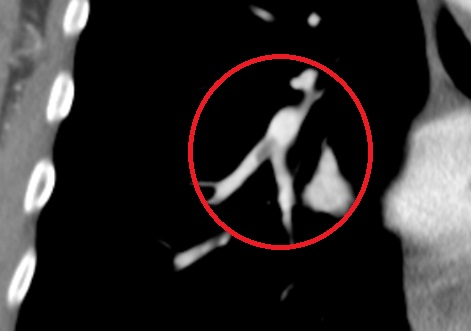
Now we move on to one of the clots.  This one is from one of the standard CT slices.  The white and gray shape is a pulmonary artery.  The bright white is an artery full of blood, as it should be.  The gray shadowy part is a blockage, without flowing blood.  This one was the big one, we think, as it extended through several slices.


And finally, that same clot as viewed by the ninety-degree image-processed composite.  In this one it’s really easy to see the pulmonary artery and the blockage inside.


Fascinating stuff, if you ask me.  Enjoy.

08 September 2013

Little Things

The experts, whether self-declared or real, often like to talk about how society gets itself back to a state of normalcy after some significant event.  Little things start to return that signal that life is returning to the way we expect it to be.  For me, life isn’t yet back to the way it’s supposed to be yet, but some things are coming back like those sprouts of green after the forest fire.

A couple of days ago marked two weeks since the Big Slice, and I celebrated the event by paying a visit to Dr. Foot Doctor to have him remove the sutures from the point of insult.  Someday I’ll have to audit a course on surgical suturing, because clearly there are some neat tricks to be learned.  I hadn’t seen the back of my heel since Dr. Doctor autographed it a half-hour before surgery – literally, it’s one of those, “Let’s not cut the wrong spot” procedures, as in, “It’s this one, right?  Great, I’ll sign it!” which he proceeded to do, complete with some amusing artwork, I’d learn two weeks later when it was finally unveiled… But I digress…  Point being, I expected to see an Igor-like collection of stitches crossing and re-crossing the wound, as he’d done the last time around five years back.  This time, somehow, he’d artistically managed to make one thread tie the whole thing together, and with one long pull, he slid it out like the trick of yanking a tablecloth from underneath a completely set table.  Before I’d had a chance to get a good look at just how he’d woven that seam, it was out, with a tiny pinch that was, truly, the first sensation I’ve felt of the suture itself since the deed was done.  Now that’s artwork.

Sadly, I’m still confined to crutches for another week before beginning the slow transition to the Dreaded Boot, but gladly, and this is a huge gladly, once that suture was removed, the spigots were opened, literally.  No more requirement to keep it dry, which means, well, if you’ve never had to live with washing your hair under the tub spout and waddling on one leg clumsily into the tub keeping your leg hanging out, you simply can’t appreciate the joy of the return of the little thing known as a shower.  On a stool, generally sitting down save brief one-legged risings, of course, but the relief of the return of this little thing signals that this too will pass, normalcy will return.

With the easy of getting clean restored, it was time for more little things, so Saturday morning it was donuts with the local club, even if I didn’t put in the miles beforehand to burn it off.  Put it on my account, we’ll deal with it later.  And after that, back to the gym for the first time in weeks to stumble around (getting onto those machines on one leg is harder than you might think!) and pump some small amounts of iron.  I often think that the upper body work doesn’t have much effect, but I am now assured that it must be doing something.  Those workouts generally don’t cause duress, but today, a day and a half after the first one in weeks, well, ouch.  I hurt, a lot.  Good pain.  I saw this coming when I realized that I usually walk out of there with wobbly arms, but this time, being on crutches, I needed those wobbly arms to walk out.  It wasn’t easy.

Another week on these stilts and I’ll get my arms back, a huge plus, and start to heal up the abuse to the remaining good leg which has carried an inordinate amount of lifts, twists, and other slightly unnatural motions.  Normalcy will return.

But enough of that, I know that long-time readers of this series have one and only one question on their mind:  where are the pictures?  What’s taking so long?  And so I issue my now usual SQEAMISH ALERT, warning you that reading further will bring either a treat to your curious eyes or revulsion if you are so inclined and/or just ate lunch.  Seriously, there is absolutely no blood in these pictures.  The tourniquet worked wonders!

The good news, as already related, is that the procedure was routine, quick, and at least at the time, successful, though true success won’t be known for weeks.  Dr. Doctor reported that unlike many of these, where he finds the tendons with significant amounts of gray or yellow degraded and unhealthy tissue, with mine he found only solid, white, and strong stuff.  Healthy, save that concealed slit inside.

The bad news is that his photographer wasn’t terribly prolific this time, and the result was a mere two pictures, neither of terribly high resolution.  To stretch the plot a bit, I’m including both the pictures as delivered – setting the overall scene, you might say – and some cropped close-ups of the action.  Here we go…

First, having performed a high-scoring face-plant on the table so that my heel was nicely facing upward (because working on ceilings is difficult and tiring), Dr. Foot Doctor has already made the incision, and a three-handed person has applied the traditional salad forks to expose the beast.


The beast, being my wondrous and pesky Achilles, is, I must say, much larger than I’d imagined it.  To be fair, this is the spot where it is enlarged a bit from the internal tear, but still, I was surprised at the solid meatiness of the thing.  I guess when you consider what it has to do, it makes sense.  This next shot is really the same as the last one, but blown up just to focus on that significant sinew.


Once open to the world, out comes the famous Topaz wand, the micro-debriding wonder which comprises half of my hope from this procedure.  This shot shows that the secret is out, the gig is up.  There wasn’t really a three-handed person in that last one.


 Dr. Doctor proceeds to attack Sir Achilles with his saber, piercing it a total of nine times, with the intent of getting blood to flow into the tendon where none would otherwise, and stimulate healing.  As before, this shot is a cropped and zoomed version of the previous one, focusing on the Topaz penetration.


And sadly, that is all I have for pictures.  Following the Topaz, Dr. Doctor made what he described as a lateral stitch, which I believe basically means he wrapped a stitch around the tendon to hold it together while the internal tear heals.  That internal stitch dissolves on its own, unlike the “seal ‘em up” external one that he pulled out the other day.

My job has been, and continues to be, not to flex that tendon.  Considering how much it has NOT hurt, this has been especially hard, because you’re simply not thinking of it when you go to get yourself off the sofa.  Nevertheless, so far, so good, and I’ve got my fingers crossed that this will work!!

30 August 2013

Is It Worth It?

Here I sit with my left lower leg foot and swathed in bandages and crutches resting next to me, waiting for that next time I need to hobble somewhere.  Since my office is in the basement, this means planning ahead for basic things like use of the restroom.  My hands are rather bruised from excessive crutching around at a company meeting yesterday (fortunately it’s my left leg that’s out of commission and I don’t drive a stick-shift anymore, so I’m not confined to quarters).  No matter how fit I was, my muscles weren’t prepared for the assault on my right leg and adjoining parts, or the sudden demand on my left calf to hold my leg up for so long while moving about, so things hurt.  And all of this is because I had to repair an injury that didn’t stop normal activities and was pretty clearly caused by this obsessive habit of running and racing a lot.

Let’s put this in perspective.  What I’m dealing with is nothing compared to what others have endured, whether the victims of the Marathon bombing or the results of last night’s car wreck on the freeway.  This is kids’ stuff by any measure, so I’m not complaining loudly.  But the irony can’t be lost in that in a quest to be healthy, I brought this on myself.  Consider that I was completely mobile and functional as I walked into the hospital to have this done.  Indeed, in defiance, I went for a run just an hour before reporting – with some pain, mind you, but fully capable of what the average Joe would consider an acceptable level of exercise.  It wasn’t like I’d snapped or broken something and had no choice.  This was my option so that I could get back to high-intensity running and racing sooner.

So one has to ask the obvious question:  Is it worth it?

Let’s back up a bit and paint the picture.  I’ve been battling a pesky problem in my left Achilles for a good year and a half now.  If I had to pin it down, which I’m not sure I really can, I’d point to the folly of trying my first five-thousand-meter indoors on the track back in January of oh-twelve… in track flats…  that I’d just bought a couple weeks earlier… and had run in for all of about two miles total.  As an old friend used to say, “Don’t be a fool, you idiot!”  But I did it, and my calves screamed for a week, right up to the indoor half-marathon I hammered the following week with two-hundred and sixty-some sharp left turns.  Oddly – gee, what a surprise – about the time the calves calmed down, the Achilles started hurting.  I can’t be certain, but if I had to pick a stretch out of the constant stream of bodily abuse that may have started this ball rolling, that may have been it.

In true runner fashion, I did what any other obsessed athlete would do:  I tried to run through it.  This wasn’t as foolish as it may sound in hindsight, because it really wasn’t so bad.  Over the course of the next year plus, I trained hard and found personal-best success in almost every distance.  That pesky Achilles reminded me it was there from time to time, but never raised itself to the level of a serious worry.  Or at least it didn’t do so until a few weeks after this year’s Boston Marathon, when it decided it was indeed time to raise itself to the level of serious worry.  Some seriously reduced training didn’t cure it, some time off didn’t cure it, so it was off to my favorite medical professional, Dr. Foot Doctor, for some advice.  To my surprise, I got not only his professional advice but his personal, first-hand account as well.  Once we’d determined the verdict – a vertical tear in the Achilles – a place with nearly zero blood flow and therefore nearly zero healing capability – he related that he’d suffered the same fate, and without treatment, it had taken him nearly a year to heal.  Not willing to wait that long, we opted for treatment, which consisted of perforation of the tendon with a Topaz wand to incite blood flow and healing, and a lateral stitch to hold it all together during the process.

Result:  painkillers, three weeks on crutches (one down, two to go), a few weeks in the Dreaded Boot, then slowly rehab, regain fitness, regain fighting form.  Cross country season, sayonara.  Fall marathon, she’s gone, good-bye.  Competitive indoor season?  Highly unlikely (ooh, and the thought of track flats again?  Hmmm…).  Adding that to an already lost summer racing season, is it worth it?

So-called normal people ponder the standard goal of recording some aerobic activity for twenty to thirty minutes, three times a week, and shudder.  So-called normal people don’t see what we see in this sport, and don’t do what we do.  It would be so easy to back down to the level of normal people.  After all, the level of discomfort wasn’t really a factor on a three-to-four mile easy slog.

But if you’re reading this, you already know that the standard goal doesn’t do it for us.  We push harder, we endure the workouts, commit the time, suffer the pain, and despite what that might say about us, love it.  And the funny things is, while I may have brought this on myself, the more I talk to normal people, who become far more verbal about their medical history when they see you on crutches, the more I realize that if it weren’t this, it would be something else – something else that normal people have to deal with.

I may have put a vertical slit in my Achilles, but normal people who aren’t in shape go out on weekends and blow their entire Achilles in to smithereens.  Normal people blow out their ACLs when they smell a company softball game.  Normal people encounter all sorts of problems that they might not have seen had they been a little stronger, in a little better shape.  Not to say we don’t, and won’t, have normal issues as age creeps inexorably onward, but the clear picture you get is that not being obsessive about fitness is not a ticket to avoid the need for various repairs such as that I’m recovering from.

So is it worth it?

Returning to running has redefined me in a satisfying way.  Running – and racing – has brought innumerable new friends, by and large the kind of people I truly enjoy, focused, strong people who certainly enjoy a brewski but don’t define their life by their alcohol consumption but instead by what they can accomplish.  Running has provided adventure, motivation, success, pain, and pleasure.  Running has brought measureable health benefits.  In short, running has provided a great life over these past eight years.

When asked, I coach people to think about the long term, think about what it will take to still be running ten years from now, rather than worrying about next month.  It’s a tough pill to swallow when it’s on your own plate, but I forced myself to follow my own advice and get this thing fixed at the expense of near-term goals but in the interest of still being out there many years from now.  This too will pass.

A little short-term misery?  It’s unquestionably worth it.  I just hope it works!

26 August 2013

Beds & Meds

My rock & roll month of packing in every bit of living possible before the Big Slice came off as planned.  For those keeping score, I managed to sleep in ten different places over the first twenty days of August.  (Yes, home counted, but only for one…)  That all came to a screeching halt Friday morning, when the Saints of Marlborough Hospital laid me out on the slab for the dissection.  Now, nicely medicated against what has turned out to be a surprisingly small amount of pain, I’ve got – at least in terms of running – nothin’ but time.  Time to rest and recover with a lot of hard work down the road to rehab and regain racing form, but for the moment, just time.  Dearest Daughter the Younger coined the catchphrase for the month:  Beds to meds.  I love the irony.  Hey, you might as well take joy from wherever you can find it, right?

Getting there is all the fun.  After last episode’s Adirondack Death Marches, DDY and I headed to New Hampshire for a few Death Marches of our own.  In a bid to obliterate the Adirondacks’ reputation for having rougher trails than the Whites, we directed ourselves up the North Slide of the Tripyramids, a monster that rises twelve hundred feet in a mere half mile – do the math, that’s an average forty-five percent grade.  This thing is a trail only by virtue of the fact that paths lead to and from it, and that someone built a few cairns on its upper reaches.  Otherwise, it’s merely a climb, and while not quite of the ‘butt-hanging-in-the-sky’ caliber of trails like Acadia’s Precipice, it’s clearly in the daunting category. 
There’s nothing like watching fist-sized rocks whiz past your kid’s head while you clamber hand-over-hand for the next tenuous root upon which your life will depend for the next thirty seconds.  Yes, this trail was proof that time heals all wounds.  Otherwise there’s simply no way I would have done this again, had I recalled its intensity from my last trip up some twenty-two years back.  Needless to say we survived the ordeal, as well as the following day’s excursion which brought DDY to the half-way mark of her quest to summit New Hampshire’s four-thousand-footers (and my second trip around, in keeping with this blog’s title, having wrapped up my first round of these peaks back in ‘ninety-five).

Home no more than a few nights, we set off again for a third trip to New York State in two weeks, this time to celebrate a family wedding, pay some social calls, and scope out colleges in the Big Apple. Translated to the “Let’s Trash the Achilles Before Surgery” mission, this meant miles upon miles of pavement pounding, highlighted by New York’s new High Line elevated-railroad-turned linear park, the classic Brooklyn Bridge walk (don’t die without doing it), and a surprise entrant to the ultra-cool places to walk and run, Poughkeepsie’s Walkway Over Hudson, a two-hundred-foot high, mile-and-a-quarter long rail trestle turned spectacular walk.  Or run.


Yes, in the midst of all this commotion, my diabolical plan was to run to the end, knowing it would be a while before I can hit the roads again.  Having taken the June break and the May-through-July slowdown, slowdown has been the key word for any miles lately, yet I was amused to find that among the hundreds of runners in New York’s Central Park, I was still the passer and not the passee.  After registering runs in seven of the month’s ten bedding locations, pride kept me going up to the last morning, when I popped in four and a quarter just an hour before reporting to the hospital.  Being accustomed to two hundred fifty miles a month, merely topping a hundred for August wasn’t a big deal, but hitting it just before the slice did feel pleasantly defiant.  And besides, I didn’t have to re-hydrate afterward, as the nurses had a nice IV bag ready to do that for me.

And frankly, that IV was the worst part of the whole ordeal.  I am a Certified Wimp on that score, but once past that, this repair thing was a breeze.  The procedure, according to Dr. Foot Doctor, went well.  As he’s once again promised pictures (can’t wait!), I’ll leave the details brief here for now, but in short, after slapping myself down face-first on the slab and imagining I was in for a good massage, I instead took a nice chemically-induced nap while he filleted the back of my heel, punctured That Pesky Achilles nine times (take THAT you troublesome bit of flesh!) to promote blood flow and healing, added a lateral stitch to hold it all together, and Zip-Loc’d me back up.  Less than an hour later, I was back in the real world, riding my horizontal chariot to recovery.

A big part of the reason this was so easy is the cadre of Saints at our local hospital.  The nursing staff is simply awesome; attentive and caring of course, but also performing with a cool competence that is both comforting and confidence-inspiring.  They deserve songs of praise, so imagine I’m singing as I say thank you to Enid, Patrice, Carolyn, Barbara, Sharon, and everyone else I missed.

Later that day, save for a bad trip on some overzealous meds, soon replaced with merely zealous and well-functioning meds, I found myself in so little discomfort that I was tempted to suggest that Dr. Foot Doctor merely performed placebo surgery, with the intent of getting me to stop running long enough to let things heal on their own.  Of course that’s not the case, as a bit of random pain and swelling and the inconvenience of being back on crutches have reminded me, but really, this is nothing at all like the misery of that last repair back in ‘oh-eight.  It’s merely a small price to pay for the joys and benefits that a life of running has brought.

I’m already on recovery Day Three.  This cast and crutch thing will be gone before you know it, the boot will come and go, and I’ll start the road back.  Keep smiling, it’s only eight months till Boston!

10 August 2013

Insulting the Injury

Mother Nature has a way of hijacking your plans.  The originally intended theme for this week’s musings bubbled to the forefront of my gray lobe while I was actively abusing my body in New York’s Mud Zone, the Adirondack High Peaks region, earlier this week.  I’d been thinking of my decision to return whole hog, to whatever level of training I could muster in order to gain whatever conditioning I could before my impending immobility, as well as assure that Sir Achilles looked good and angry when Dr. Foot Doctor went in.  No point in him wondering which part hurts, right?

Having delayed my date with the scalpel because of August’s packed schedule – and part of the reason it became so heavily packed was precisely because of that looming scalpel – it occurred to me that what I was doing was living to the max before an unavoidable deadline.  Thus came to me the theme, “What would you do if they told you that you had only so many days left…”

Now of course what I’m facing isn’t the end, it’s just an interruption.  But knowing it was coming I’d not only jacked up my mileage, but planned a couple significant mountain treks, sandwiched between business travel, college tours with Dearest Daughter the Elder, and a family wedding just to make things complicated.  But Mother Nature doesn’t care about your plans, and she has a cruel sense of humor.  Or perhaps she does know about your plans, and likes to subvert them, or is impatient to just get on with them.  In my case, my plans are to have my Achilles rather brutally stabbed with a Topaz wand to cause bleeding and, hopefully, healing.  This morning Mamma Nat figured she’d get in on the act a little early.  She took it on herself to entirely brutally stab that very same Achilles with one of her finest soldiers as I human-powered my seriously retro squirrel-cage push mower around the homestead.  I can’t say which version of stinging machine it was, but I can say it was the most intense pain I’ve felt in a long time, and a long time it was, lasting till even now.

With mountain trek number two launching at an ungodly hour tomorrow – indeed I should be sleeping now – this was simply an insult on top of the injury I’m already dealing with.  So while I had been thinking about how much living you can squeeze into the time you’ve got, I suddenly found myself dealing with an ironic insult.  And the irony was layered:  Heck, why pay for a doctor and a hospital?  Just let some insipid insect inject insulting injury into the source of your woes, and maybe, just maybe, it will bleed, it will swell, and it will heal!

Cut to reality.  I can only wish for such a miraculous recovery.  More likely, I’m just hoping it holds up while we scale the rockslides on the Tripyramids tomorrow.  Save for this insult, the chances are good, since even in its injured state, it held up to thirty miles and ten summits over two days in the rough-tumble-and-mud-entrenched ‘dacks earlier this week, or in other words, I’m slipping in a segway to the original idea:  Live it up, you’ve got only days…

Hiking significant mountains in the east, significant here being defined as four-thousand-feet and over (go ahead and laugh you folks out west, but just remember, we don’t believe in wussy things like switchbacks or trails graded for horses), generally involves a simple formula:  you go up, you might bounce over a few lumps while up, and you come down.  But my Intrepid Young Hiking Partner hasn’t quite learned those basics.  For him, the formula involves drawing a squiggly line on the map, more or less ignoring those pesky little contours on the topographical map.  OK, I embellish a bit here, in truth he knows well what he's up to, he's simply seriously aggressive with his plans.  And with the hospitality his family offers in their slice-of-heaven Adirondack lair and his enthusiasm for the mountain equivalent of the kill, who am I to complain?

On a perfect Monday morning, sunny and forty-three degrees at the Adirondack Loj (yes, proper spelling), he, I, and a trail buddy we’d met last year set off for phase one of the day, a relatively run-of-the-mill twenty-five-hundred foot ascent of Mt. Colden.  Save for the gale-force winds up top, it was a simple and perfect ascent, with expansive views from the Great Range, to New York’s ultimate summit Mt. Marcy and it’s many nearby siblings, down the amazing plunge to Avalanche Lake, and across to the McIntyre Range, our next target for the day.

Oh, but there was that detail of the plunge between us and the other range.  This was where we tossed out the usual up, bounce the lumps, and down rule, by inserting another complete down and up before even getting to the bounce bit.  Two thousand feet down, and not an easy two thousand feet, but rather two thousand feet of slick steep slabs almost entirely canted diagonally to assure maximal podiatric and quadriceptual abuse (yes, I just turned a muscle into an adjective, call the Grammar Police!).  And that’s not to mention the delightful alpine cliff-side ladder, an Adirondack specialty, strategically placed to make access certainly frightening if not overly technically difficult.  Mentally and physically, we were worn, but that was only phase two.

Phase three brought another nearly two-thousand foot rise in an unreasonably short distance, a relentless climb by any description.  But while I’d been the laggard on the phase two plunge, my body simply despising the shocking abuse of descent, phase three let the runner endurance and more importantly the runner mentality pay off.  Once into a rhythm, the marathoner mind just churns the body onward, damn the insanely steep rock piles, damn the insanely steep slabs, damn the obvious weariness, damn the torpedoes, we don’t quit at mile twenty-three and we don’t quit on the mountain, either.

Reaching the ridge of the McIntyres, with an incredible view of the fresh landslide on Colden delivered by Hurricane Irene in 2011, we finally resumed the basic formula, bouncing over the lump of Boundary Peak to reach Iroquois, before bouncing back over Boundary and ascending yet another half-a-thousand or so to Algonquin, a peak I’d last visited in 1985, some twenty-eight years ago.  This time, it was better, and not just because of the weather, but because twenty-eight years later, I (we, really) still could, even after already climbing that first mountain.  That being said, with a solid five and a half thousand feet of climb under our belts, we were fully spent on the way down, and unanimously elected to eschew our last planned summit for the day since we’d all three already bagged it earlier.

Thoroughly fried, Intrepid Young Hiking Partner and I did what any other hard core hiker would do, and headed out again the next morning.  But fear not, we’re crazy but not stupid, and cut down our planned four major summits to merely two (and a few minor ones along the way).  As we neared the end of this second numbingly wearing trek, Intrepid Partner had elevated his total to forty-four of the Adirondack Forty-Sixers, with plans to finish the quest within a week, and I, who’d never really considered this quest realistic, found myself at nineteen.  Or in other words, hooked.

But more importantly, I relished how much living I was packing into the brief time before the Big Slice on the twenty-third, and pondered how all of our lives could be so much richer, fuller, and more productive if we only remembered that there is a finish line out there, somewhere, hopefully way out there but certainly out there, for all of us.

What would you do if they told you that you had only so many days left…

29 July 2013

Date With A Killer


Despite the fact that I’m happily married, I’ve got a date coming up, and it’s not not with Dearest Spouse.  In fact, I’ve got two dates, really; the first with my old buddy, Dr. Foot Doctor, and the second with a killer.  Yes, I’ll be spending the weekend with a pain-killer, or more likely multiple such killers.  Gee, I can’t wait.

In the roller-coaster of life, there’s a dip ahead, and I don’t mean that slightly lost-looking guy down the street.  In my uneducated way, I saw hope in that seemingly devoid-of-white-spots MRI.  A high point, perhaps the pain was in my mind, perhaps I could beat it down with a few meds, beat it in general.  Then a drop in fortunes when I was reminded that I am not, in fact, a doctor, and just because an MRI looks pretty doesn’t mean all is pretty.

At that point, coming off the meds, feeling pretty good, yet having been told that Sir Achilles wasn’t truly whole, there was only one way to find out what was really happening:  run.  And so run I did, leaving Dr. Foot Doctor hanging for a week while I tested out the healed / no-healed state of the heel, not with easy jogs but with some real miles.  Within a few days it was right back to its old tricks, and the verdict was clear.  Once again Dr. Doctor had been right when he told me that this kind of injury simply wouldn’t heal by itself without less than about a year of inactivity – an option I’m just not willing to entertain.  Having absorbed the verdict, it was time for the sentencing.  I made the call.  Let’s fix the bugger.

And on that call, Dr. Doctor reminded me why he is such a favorite and why I recommend him frequently.  When last we’d met, we’d talked about treatment options, the best being the use of the Topaz wand, the very same device he used as part of my foot tendon repair five years ago.  This time, however, with nothing severed like before, the procedure was simply to use the wand to initiate blood flow to promote healing, since the reason that tendons don’t heal is that they simply have no blood flow – especially for an internal partial tear like this.  His thought was to do this as it is commonly done, right from the outside, simply piercing the skin for each Topaz puncture.

But during that week when I’d left him hanging on my intentions, he’d taken the initiative to contact the firm that makes the device and related the details of my case to them.  (I was tickled when he relayed to me that he told them that his patient was an ‘elite athlete’!  Really?  Cool!)  They advised him that additional precision was in order for my case, and despite the additional healing involved, he should open it up to see exactly where to apply the Magic Wand, rather than stabbing blindly from outer space.  A little more on the recovery side, but more likely to be effective.  I’ll take that trade-off.  And I’ll say thanks to the good doctor for making the extra effort!

All things being equal, once that decision was made, I’d just as soon get it done in the next five minutes, not stew over it, and be on the road to recovery that much sooner.  But life being as it is, there’s simply too much stacked into the next few weeks to make myself into an invalid right away.  Thus I’ve got another twenty-five days to think about it before we slice and dice.  And besides, Darling Daughter the Eldest might be having her wisdom teeth out at that same time, so what could be more fun than to down Vicodin together for a weekend?

With twenty-five days to wait, knowing I’m going to fix this thing anyway, what to do between now and then is obvious:  run, run, run, hike a bit, and run.  No racing, nothing foolish of course, but certainly running.  There’s simply no point in going into a long break in any worse shape than I have to be.  I’m already up a few pounds from cutting mileage and taking much of June and early July off.  Might as well work it off now and start from a better place.  Besides, when Dr. Doctor opens that tendon sheath, I’d like it to be real obvious which part he needs to fix!

The fall season is shot, no cross country, Mount Desert Island Marathon won’t happen this year, but if all goes as hoped, an eighteen-month nagging pain will become a thing of the past.  It’s time to live what I preach and worry about making sure I’m running in ten years instead of next month.