29 July 2012

Credibility Shot

I feel rather sheepish. Staring at the yawning chasm of nearly two weeks since last writing (I know all six of you readers are sitting on the edge of your seat in anticipation) I’ve been trying to conjure a way to accurately describe my state of being since officially declaring Slump. Indeed, things dropped so low that things actually started dropping, to the extent that Tuesday night while running a hill workout with my local Strider buds, I took it almost literally on the chin when a large avian being bombarded my left shoulder (it must have been large by the scale of the result). OK, not my chin, but close.

Everyone told me when that happened that I should run out and buy a lottery ticket. I admit it, I didn’t. I could’ve been a multi-millionaire by now, or more likely just a dollar poorer. But you have to admit, it was a rather rare event. In my forty-nine-plus years it’s never happened to me, and considering how much time I spend outside, that’s somewhat surprising. But there it was, a wet, darkly evil-looking splattered mess released from above with devastating accuracy. Yee-umm!

In the mood of, “Can it really get worse?” (to which the answer is, “Of course it can, you fool!”), I spent the next couple evenings trying to wax poetic about this excremental event. Surely there must be a way to knit such an omen to my stiff, pained, and slow status, and find a ray of sunshine to cast upon my readership! But by Friday, all I’d come up with fell clearly into the corny column. With a big race pending in the morning, I abandoned my lonely writer’s garret to await Saturday’s results, expecting them to be tinged by slumpiness, giving further ammunition to weave an even deeper and wiser tale.

Except that it didn’t happen. Saturday turned in about as big a surprise as what hit my left shoulder on Tuesday evening. Perhaps it was telling that when the gun fired, I wasn’t paying a bit of attention. Time to go? Really? Surprise! What transpired in the next half an hour is what brought on the sheepishness. I know you’ll never believe me when I say the word slump again.

The much-anticipated and, due to my training funk, somewhat dreaded event was the next in the series of USATF New England Grand Prix races, this time the 34th Carver Cranberry Five Miler. Recalling what happened in Bedford New Hampshire back in May, I had zero illusions that the field would offer anything in the same league as the word forgiving. Even had I been at the top of my game, I knew the competition would be crushing. Add to that the fact that I’d volunteered to act as team manager for Greater Boston’s men’s masters team, raising my visibility within this club of fast guys, made me just the tiniest bit concerned that a slump-induced train wreck might just happen to get noticed. Not that they’d get worried or upset or anything, it was just me having a good fret. Hey, it’s a free country, I can grow my own worries if I want to.

Which is why it was probably for the better that after a rushed warm-up, feeling more or less crappy, already soaked from the hugely humid but mercifully mild morning, I was entirely taken off guard by the gun. In smaller races I’ll toe right up to the line or close behind, but not, as I learned at Bedford, in a Grand Prix,, where only human Ferraris dare to tread. Not being up front, and with an odd lack of pre-race announcements (or perhaps I was simply oblivious), I truly had no idea – BANG!

There was no forgetting Bedford. I fully expected a huge field consisting of every ringer in New England to precede me through the cranberry-bog-laced countryside. But even with that expectation, the scale of the humbling shellacking was impressive from the outset. If there seemed to be a brigade in front of me at Bedford, this time it seemed an entire army. That’s no surprise in a big race like Boston, but in a race of just under six hundred, it’s disconcerting.

As at Bedford, I missed the first mile split, and had no idea how fast this train was rolling. But mile two confirmed we were on the Tokyo to Osaka bullet express. I thought back to the stride workout I’d done Thursday night, eight-hundreds on the track at a little faster than five-K pace. With only forty hours till the race, I’d wanted to feel race pace but not overwork, so these weren’t interval- fast, but solid, with a few minutes recovery between each. I knew that the real goal would be to string six together back-to-back sometime to finally nail that five-K personal best. Here at mile two in Carver, I’d just strung four. Except this was a five-miler, not a five-K, and it was obvious that stringing ten wasn’t in the cards without immediate defibrillation available afterwards.

It’s a dangerous point in a race when, early on, you know you’ve got so much time in the bank that a great day is possible if you can just hold on. You’re faced with the choice of just holding on or pressing for gold. In a Grand Prix race, where medaling is really out of the question, and your team, while important, isn’t likely in the running to take the crown, pressing for the gold with every iota of effort is a tough order. But just holding on is a downright, well, cop-out.

Here I was somewhere in-between. I had a lot in the bank, but not so much as to be able to mail it in. And I’d hadn’t even hit the halfway mark. While I can tell you that mile three sagged from the initial pace, and mile four sagged more, I can say that it wasn't because I was just holding on. Unless you count just holding on for dear life, trying to grab the various parts that were flying off and hold the machine together for two more, one more, another half a mile…

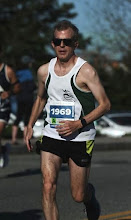
Two pictures tell the story. Early in the race, a shot that I’d be happy to show my mother. Late in the race, form failing, mouth agape, brow sunken, essentially looking like hell. Laughing at myself at how I matched the bit I’d read in a running tips book (to be the topic of a future post) where the author commented that at 100% effort, race pace, you’re unable to wipe the spit off your chin. But still knowing that barring collapse, a personal best was in the offing.

And then it was out of the offing and into the bag. And to make it sweeter, it wasn’t just an official personal best, but also ahead of the interim split, my previous unofficial personal best, from Bedford. And my age-adjusted rating matched that of Bedford, tying this for a best-ever race.

Of course, place-wise, I got utterly slaughtered. Even worse than Bedford. But hey, it was a Grand Prix, what do you expect?

If I feel crappy this week, you’ll never believe me if I tell you I’m in a slump.

Thanks to Krissy Kozlosky of krissy.smugmug.com for the early race shot, and Ted Tyler from www.Coolrunning.com via www.JimRhoades.com for the horrid late race shot. Not that Ted took a horrid shot, of course, it was all my fault.

16 July 2012

It's Official

I heard on the news that they declared Syria to be officially in civil war. Gee, what a surprise. I’m making my own similar declaration today. Yes, I’m “officially” in a summer slump. Gee, what a surprise.

This seems to happen every year, and every year I question whether this is the beginning of the end, the start of that long slow slide to aged shuffledom, the piercing of the aura of being the fountain of youth, and no, I didn’t make that up, a business colleague uttered that one the other day to which I sputtered, choked, and lay dead on the floor. OK, it wasn’t that dramatic, but it’s been feeling that way. In any event, these slumps arrive, I ponder what malady is killing me, and a few weeks later normal life resumes. Or at least it has in the past; this time the jury is still out.

Yes, I know I just notched a personal best in that ten kilometer two weeks ago. It’s still a slump, and it started even earlier than that. I just haven’t declared it officially till now. Thanks, Syria.

During our annual week in Acadia National Park in Maine, there were a few days that were just plain brutal. One day’s measly three miles that left me ready to wilt and drop in a gelatinous heap on the pavement. A repeat a day later, pleased that I had the excuse of being on a comfortable slog with my daughter, since I didn’t think I’d be going much faster had I been alone. And an attempted track workout where I couldn’t blame my sloth-like velocity on the bizarre dimensions of the Mt. Desert Island High School track. Really, it’s a strange track with the longest turns I’ve ever seen, and it seriously throws you off, but just as seriously, that wasn’t the problem.

Characteristic of these slumps will be mini-anti-slumps, only to return to slump-dom shortly thereafter. This year’s Maine trip produced some lovely runs within the park proper, more than I typically get in during our trip, including the fun of pulling running shoes out of my pack, leaving the hiking boots behind, and hammering my way back (around the mountains on the road) at the end of a long point-to-point hike to retrieve our vehicular transport and recover the family unit. That one was a hoot, thirty-eight minutes to unwind four or five hours of hiking. But slump-dom returned.

And since then? Ever the obsessive, my training log spreadsheet (yes, of course I have a Total Geek Spreadsheet, you must have known that) has a check box for each workout where I can elect to ignore the pace of that day’s run in the calculation of the month’s “average training pace” – a measure that provides some insight into racing readiness. The check box is there for days when a pace calculation isn’t possible or practical, or for days when, due to social reasons, that day’s pace isn’t representative of normal training. Like an addict coming clean I have to admit that I have severely abused that little box over the last several weeks, taking the, “This one doesn’t count” out more times than not. Definition: Slump.

Heat? Perhaps. Humidity? Highly likely. Foolishly pushing past nagging injuries, like that Achilles that just won’t quit, or the recent stiff knees? Who’s to know? Simply overtrained, the streak coming home to haunt? Maybe, but let’s not jump to conclusions and kill it off before we really know. All I can say for certain is that the beginnings of most runs this past week have been pretty downright miserable. And in some cases, the middles and ends of those runs have paralleled.

For example, this morning’s expedition in Rochester – the one in New York, that is – started off at just plain awful, and ascended to notably unpleasant by the time I’d reached downtown and my planned break to overlook Rochester’s High Falls. The return trip scaled to the pinnacle of somewhat unbearably long before finally concluding in the state of soaked and wilted. That’s just how it’s been. But hey, the falls were really a nice sight. And tomorrow’s forecast is only for the mid- to high-nineties. No big deal.

This too will pass, and that’s part of the lesson, I keep telling myself. Life isn’t up, up, up. It’s got downs, sideways, and a few out-of-control skids now and then. Slumps will come. They’ll usually go. Until one day they don’t, in which case we simply learn to live with a new normal, the version of reality that will rule from that point forward. It’s inevitable, and we might as well enjoy the ride.

04 July 2012

Dog Should’a Ate My Homework!

Be a good boy, always do your homework, and you’ll go far in life, right? Seems like good advice, and it usually is. This time it held true just a little bit too literally, notably on the latter end of that statement. Here’s one time when I wish the dog had eaten my homework. Except, of course, for the minor details that this kind of homework couldn’t be eaten, and that I don’t have a dog.

One week after writing about the hazards of for-profit versus non-profit club racing, I dipped my toe into a for-profit race. As I said, it all comes down to attitude, and I’ve casually known this race producer for some time. He’s local, he’s not Big Corporate, and he’s a runner, so I don’t mind that he does this for a living. Besides, that Groupon-like email with the half-price offer was compelling. Who says I, Joe Frugal, can’t be swayed by a low price?

And the event in question is, to be entirely frank, worth a few bucks just for the fun and experience, never mind the racing part. The Harvard Pilgrim Finish-At-The-50 combines the schmaltz of the NFL with the world of running. I’m no big fan of mainstream pro sports, but that’s not to say I don’t enjoy watching the Patriots (when they win, of course), or can’t enjoy the opportunity to play in their sandbox. This race serves that up: the finish consists of racing through the inflatable Patriots football helmet – the one that the team comes through at the start of each game – onto the field of Gillette Stadium, surrounded by its sixty-eight thousand seven hundred and fifty six seats,
many filled with family and friends, to finish, as the name says, on the fifty-yard line. Never mind that the field is currently set up as a soccer pitch with no yard lines. It’s the same spot, you get the idea. Add some schmaltz, a few Patriots cheerleaders (OK, eye candy, not schmaltz), the Patriot mascot, a real Patriot just for show, put it all on video on the huge stadium screens, and note with glee that your family is sitting in front row, fifty-yard-line seats, a feat never to be repeated, and it is, well, fun. Then add fireworks afterward, and the traffic is, well, legendary.

But the theme today is homework, and how doing it will take you far in life. So let’s back up a day.

This is not a small event. Pre-registrations exceeded five thousand against a stated cap of six thousand which in itself was exceeded. And this is not an elite event. No Boston-like field where eighty percent are qualified and know the ropes for race prep and logistics. No, this is a collection of everyone who finds this football-relation thing interesting, and there are a lot of those, and bless them, they’re not all astute racers. You can expect a lot of people converging on this to run a five kilometer that might not do it again till next year. Fair enough, good for them, but it means that I had no interest in trying to pick up my number in the mayhem of race evening. And as luck would have it, I had a business meeting the previous afternoon just down the road, so I swung into Foxborough, picked up my number, and went out to scope the course, using the map posted on the race website. Doing my homework, like a good boy.

I’ve always been a big proponent on knowing the course ahead of time. I’ve always been a critic of races that don’t post the course map, making the previous virtue difficult to attain. And I’ve seen the results of failing to attain that virtue numerous times, always at someone else’s expense, because, after all, I do my homework.

Which is why after a fast mile one, a disappointing mile two, a realization around mile three that while I’d faded off smokin’ pace and could feel in my bones I’d lost the opportunity to beat the virtual personal best set midway through the Bedford twelve-K, I still had a good shot at an official personal best were I just to hold on. And I knew the course, knew just what to expect, and figured I could do it, because I’d done my homework.

Pulling into the center of Foxborough, the course cut right and then was to cut immediately left. Except it didn’t. Or at least the guys in front of me didn’t; they all went straight ahead, blindly (in my view). I knew the map, I knew the course, and it cut left on Bird. I knew there were no street markings anywhere along the course – because I’d scoped the whole thing – so not seeing one at this turn didn’t worry me. I looked left and saw, one block down, a cop stationed at the next turn onto Baker. Seeing that cop assured me that I knew the course. “Left!” I shouted to the field (who of course ignored me), and made a wide-swinging, very non-tangential, hugely inefficient left turn. Because I did my homework.

And a block later the cop told me they’d changed the course that day.

Now, you can ask, why, if the cop knew that they’d changed the course, was he standing on the old course? Was he that bound to orders? You can also ask, why did they change the course that day? The answer, later research would show, that they changed it two weeks earlier, but never updated the web site, nor apparently the people who’d posted the signs warning locals of road closings, which were duly posted on what was now not the course.

I more than muttered several expletives and momentarily lost my will to live. Then like a pilot coming out of a stall, I re-lit the engines and made the command decision to run the “old” course anyway, knowing that the two roads paralleled, and just see what happened. I had a nagging guilt that if the roads weren’t quite parallel, I could have shorted the “actual” course. Or the other way around, but at least that wouldn’t be guilt. My mental map of the terrain was good, but not that good.

Along Baker Street, between the “road closing” signs, stood a number of perplexed spectators wondering where the race was. For them, I was it. A half mile later the field rejoined me – nobody noticing the guy re-entering the field from the left – and it appeared I slipped in where I’d left off, so I ran it in. Through the tunnel, onto the field, eyes on the clock, despite all this a few seconds to spare, and in the end a six-second personal best recorded – if I didn’t short the course.

To be fair, finishing on the fifty when you’re really racing is far less relevant than when you’re a big Pats fan and you go for a typical participant’s maybe-just-a-little-harder-than-usual run. Those folks probably got a lot more out of the cool finish than I did, hammering toward a PR, eyes only on the clock once I’d clocked the slow five-K guy who swayed into the ten-K lane inside the narrow stadium-entry tunnel who didn’t move despite course marshal instructions and my warnings (I’d predicted that would happen, serves him right…). But once the race was done, holding après-race on the field at Gillette, with those towering rows of seats looming overhead, was undeniably cool.

A brief discussion with the race director immediately after the finish was more or less meaningless, as I’m certain he couldn’t understand a word I was saying in my post-race stupor, and with over six thousand people descending on his finish line crew, he had more things to think about. I duly reported to the awards booth, picked up my second-place booty for the forties age group, and noted I’d only missed winning it by five seconds. Bummer, ah well.

And then I clocked out that little detour the next day. As it turns out, those two streets are indeed parallel, but the street I took to get from the first to the second swung notably south, adding a twentieth of a mile. My guilt was assuaged, I had not shorted the course. I’d gone long, by point-oh-five, which doesn’t sound like much, but at my pace, that cost me a surprising eighteen seconds, not counting the momentary deflation upon learning of the re-route. That five-second gap between me and winning my age group came back to haunt.

We can analyze, understand, learn to avoid these pitfalls in the future, but that’s it. Can’t change it, so laugh, tell the story, and move on. Do your homework and you will go far in life. In my case, a twentieth of a mile too far.

27 June 2012

For Profit

I’ve got a love-hate relationship going on. The battle has been raging in my head for months, even years, as I’ve contemplated this article. The battle is not resolved; in short, I cannot take a side and will leave my conclusion vague. It’s just not a black and white topic. Let’s consider for-profit road racing (or for-profit racing in general). Is it an answer to market demand, or a perversion of a relatively pure endeavor that simply lines someone’s pockets?

First, full disclosure: I’ve profited from a racing event. I was paid for my services as an announcer at last year’s local triathlon, and would have done same this year if not for a scheduling conflict. Second, in today’s hyper-charged political atmosphere it seems prudent to state the obvious; I’m in favor of capitalism, though I’d like to see it take a bit more ethical path at times. I’ve nothing against business or earning a fair wage for one’s work. Without that concept, we’d all be in trouble.

Let’s look at the typical local club or charity race. The proceeds land in the lap of a non-profit organization of some sort, be it the local running club, which presumably pours those funds back into its mission, or the charity, which we’ll presume is legitimate and worthy. Let’s be clear that even in the smallest races, someone makes a profit. The shirt vendor, the medal vendor, the port-o-john service firm, even the hired-in-announcers, they all provide something that is needed. The investment they made to be able to provide those services wasn’t free. It’s only fair they be compensated for services they render. And in larger non-profit races, paid staff are the norm, and with good reason. You can’t pull off the Boston Marathon by volunteering nights and weekends.

In short, there is a cost of doing business. Sponsors and donations help, but at the end of the day there are things you have to pay for, because you cannot convince the entire global supply chain to sponsor each leg of their path down to your event. So when we refer to a non-profit race, we’re not fooling ourselves into believing that we’ve got some lily white angelic enterprise devoid of accounting. But at the end of the day, what’s left over goes to what we define as the public good.

Now let’s look at the typically for-profit race. From a business standpoint, it’s entirely the same thing. Vendors must be brought in, services must be procured, expenses incurred. It’s really no different. Many of these races even elect to allot a portion of the proceeds to a charity, to give the impression of (or do real) public good. But at the end of the day, what’s left over goes to the benefit of an individual or individuals.

Is that wrong?

One can argue about motives and resulting services. There’s a for-profit race series that drags its carpeted bags into Worcester now, as they’ve done for a few years. This year they elected to expand their event, adding a full marathon and a 5K to their existing half marathon. Knowing the history of this particular promoter, I choose to stay far, far away. But multiple reports from the scene came rolling in, and the picture wasn’t pretty. Six port-a-johns for well over a thousand racers. Complete mayhem at the start. Lack of marshals on the course. Awards delayed, not as advertised, not posted, heck, results not even posted. More than one person whom I’d warned about this event, but had chosen to run it anyway, came back saying, “Well, you told me so.”

It’s easy to point at this and insinuate that the promoter was cutting costs to line his pockets more thickly, and perhaps he was. But that’s a shallow approach that, while it may or may not be true in this case, doesn’t stand the litmus test. There are non-profit races that are poorly executed as well, and which suffer from cost-cutting in order to raise more funds; the pocket lined more deeply in that case is a charity, but we still expect a good product. And there are for-profit races that are well run.

I like to think of a race as pure competition, but the reality is that for most it is not really a race but an event with little competition involved, and the staging of said event is, in the end, a service. (How shall we entertain ourselves this weekend? Shall we go to a concert, or to a road race?) The for-profit promoter is, after all, providing that service. Shouldn’t he or she get paid for that?

One can argue about marketing and value. I cringe at the ads I see in running publications, where running comes in a distant second, third or even fourth, in the priority of what is being billed. Party! Bands! Visit our theme park! Pay to embarrass yourself in our mud pit! Be a rock star! Best schwag! Did anyone remember the fact that it’s a race?

Here it’s pretty accurate to point at the for-profit industry as the pusher of these agendas. Are they sullying the sport? Maybe yes, maybe no. I can’t fathom why people would pay to be chased by zombies, whatever they are, but more amazing to me is that people actually pay to be the zombies. As Don Henley sang in The Last Resort, “…Jesus, people bought ‘em.” Are you more angry at the spammers and telemarketers, or the fact that there are enough people that actually respond to spur them on? Are you more annoyed at bizarrely marketed “races” or the fact that people will pay far too much for a half marathon that claims to be an “excellent value” on a glitzy website?

So whether a race is run by a non-profit or a profit organization, there’s a wide range in quality of execution and value for the dollar. There are gems and duds in both categories. The appeal of any race is a collection of all attributes, including the organizers’ attitude. Are they in this to stage a great event for runners, or are they in this because it’s a way to make money? Attitude comes through loud and clear to anyone who takes more than a passing glance at these events. But there’s no law on defining the right attitude, and many don’t look deeper than that passing glance.

But there is an ethical issue of for-profit ventures drawing lifeblood from non-profit resources. No race survives without the contribution of many, including both race volunteers and the general public which allows it to happen. I’ve yet to see any race, non-profit or profit, where every staffer is a paid employee. No, they’re volunteers, recruited to donate their time and efforts for “The Cause”. The Cause might be just that they want to help provide a race for the runners. The Cause might be that the for-profit race does donate to a charity they like. The Cause might just be because they enjoy the activity. But think about it: they’re working for free so that someone can walk away with profit in their pocket. There are words that describe such an employer-employee relationship, and wars have been fought over them. Perhaps that’s a stretch, but it’s something to think about.

And then there is the issue of the general public’s willingness to allow these events to happen. Rare is the race held entirely off-road on private land. Most use public streets and therefore by definition disrupt public activities. The public allows this to happen on the expectation that this is a public event for public good. The public might take a dim view knowing that their inconvenience was caused by someone’s money-making enterprise.

I am reminded of two relevant tidbits. The first is the appearance in this area several years ago of drop boxes from a firm that collects and remarkets used books. The firm has an interesting business model: their service is the remarketing, and they “buy” the books by paying non-profit groups to host their drop boxes. So non-profits benefit, books are recycled, and people have a source for both disposal of and purchase of such books. All good. Except that they weren’t too clear at first about the fact that they’re a for-profit company. Make that less than totally transparent, and the drop boxes that use the word “donate” leave people feeling duped. Make that known, show the value in what you do, and all is well, though the word “donate” still seems a little misused.

The second is a political cartoon from the 1992 Presidential election, when Ross Perot made a go of it. Sadly, I can’t find an image of this classic doodle (apparently even Google can be foiled) but it showed a man walking away from a mailbox apparently having just mailed a political donation to Mr. Perot (this being the days before online fundraising), looking somewhat regretful, with the caption along the lines of how he just realized that he’d sent money to a billionaire.

And so it goes in the road racing world. What are you supporting? To whom are you sending your money? Where is it going? What is their motivation? What is the quality of the product you get in return?

As for me, I make exceptions, but make a solid effort to target club-run events. Support your sport, hang with the people who love running in and of itself without glitter and glitz, and you’ll save a heap of cash in the process.

As in the rest of life, caveat emptor.

13 June 2012

It Just Doesn't Matter

All the engineering, calculating, pondering, supposing is well and good, but at the end of the day it’s the time on the clock, and the rest just doesn’t matter. Tonight that proved true yet again, as yet again I find myself foiled on a goal.

It’s been nearly four years since I pegged my five kilometer personal best. That was on a course that I helped design, so I know it was accurate. Measuring it today with online satellite photo tracing pegs it within a hundredth of a mile of five clicks, the error being on the long (safe) side. Oh, and a minor detail, the last tenth of a mile is net downhill from the start, a bonus for nabbing a few extra seconds. Result: a personal best that’s stuck for a long time.

Make that a personal best that I have a vendetta to demolish. And I know I can do it. Four weeks ago at Bedford, I did it en-route to a twelve-K. Knocked at least ten seconds off that best mark, probably more depending on how you extrapolate, but since there was no official five-K split, nor was it even marked, it just doesn’t matter. Doesn’t count.

Tonight the opportunity availed to take another stab at it. Having passed on joining my Greater Boston brethren for the Newton 10K Grand Prix event this past Sunday due schedule commitments, I figured I’d come out of my post-Buffalo shell by popping into a local five-K that conveniently appeared only a small detour from my week’s business travel. Said local five-K advertised itself as flat, fast (assuming a train didn’t arrive and stop the whole thing mid-race as apparently happened last year), USATF certified, and last year’s results indicated the field would have plenty of fast guys to key off. As a bonus, it started with a lap and a half on the track, a perfect way to gauge early pace. Sounded to me like an excuse to take a stab at that circa-2008 five-K mark.

By now you’d think I’d know better than to expect to pop out of car after six hours of driving and run fast. Fatigued and winded on the warm-up, I fashioned in my head Excuse Number One. And I haven’t done any track work or really anything faster than tempo pace since Buffalo, and very little even at that clip, so to think a PR five-K was in order, well, I fashioned that in my head as Excuse Number Two. One of the guys I ran my warm-down with post-event laughed and reminded me that real distance runners always have plenty of excuses.

Excuses aside, it wasn’t a bad outing. Getting the body moving was far more of an effort than I’d hoped, and while that first lap clicked in ahead of needed pace, by the mile mark I’d settled down to ordinariness. There were enough fast guys, but none nearby to really inspire dropping it into the next gear, so I settled for holding on to a pleasingly consistent, though certainly not spectacular, pace for the remainder. True, the end result was twenty to thirty seconds behind the crushing PR I’d envisioned. But it was only six seconds off that 2008 downhill four-years-younger mark. And for winning the forties age group I walked off with a funky hand-made ceramic mug, hopefully not laced with lead-based glaze (I will inherently trust them). All in all, it was a decent, though not exceptional, evening.

Then it gets interesting, because I am at heart an engineer, and I cannot stop myself from fiddling, measuring, calculating, pondering, mashing and re-mashing until the numbers turn blue. Why bother, you might ask, if the course was USATF certified? Well, having been a race director, and having seen how the USATF measurement system works, where, for example, they prefer a bicycle measurement device, subject to the ability of the rider to go in a straight line, over a wheel, very easy to control and generally very accurate, I’m always curious. I saw how the USATF measurement stretched my local ten-K considerably over the wheel measurement I’d personally made with utter loving care.

Not being one to carry a wheel in my trunk (other than the one I’d slap on the car itself if needed), the only real weapon in this endeavor is the trusty online satellite photo measurement web sites, explicitly a no-no in the USATF book. But truth be told, they’re pretty accurate if you’re careful with your tracing – this is easy to test by tracing out your local track. And so I traced, and traced, and traced some more. And the result surprised me, because it came out not just a hair long, expected with the inaccuracies of the trace and the built-in margin of error in the USATF methodology, but quite a bit long. Even after double-checking and looking hard for discrepancies, well, gee, ain’t that a hoot. If that trace was right, adjusted, tonight would’ve been a big PR, on the order of fifteen seconds or so.

Next, I pulled up the USATF course certification map to verify what I’d measured matched what we ran. And here I found another surprise: the race director had started the race from a point notably further back than the hard-measured point on the map. Only a hundredth of a mile difference to be sure, but that one I could take to the bank as real. At my pace, that buys an adjustment of a whopping four seconds, which would still leave me short of that elusive PR, but would make it my quickest five-K since that long-ago day. Four seconds is four seconds, right?

And then we get to the quandary, the ethical questions, the ‘whaddayagonnadoaboudit?’ point. I have a longstanding policy of basing my personal race rankings on the most accurate measurement I can come up with. But typically I don’t adjust when it’s a certified course, unless I know there was some absolute discrepancy. So I’ll take the hundredth of a mile error in the starting line, and I’ll take the four seconds, and I’ll take the best-since-way-back-when, and plug that result into my ever-growing table of race results. But beyond that, all the pondering, positing, prognosticating, and prevaricating, well, it just doesn’t matter. The time on the clock is the time on the clock. No matter how I slice it, I can’t call this that PR I so heartily seek. Even if I think in my heart of hearts that it was real. It just doesn’t matter. The quest must go on.

But hey, the mug is really nice, and it was a fun time, plenty of nice folks to warm up, warm down, and chew the fat with, and there was free pizza afterward, so does it really matter?

04 June 2012

The Streak

Relative to what others have accomplished, what I’ve done is piddling at best. According to the website www.runeveryday.com, there’s a guy in California who’s run every day for nearly forty-four years, since 1968. Their criteria is a mere mile per day minimum, whereas mine is three, and I’ll bet he’s had far better weather on average, but really, who cares? It’s the fact that you get out and do something, anything at all, and reap the benefit. What he’s done is, and apparently continues to do, is truly remarkable. What I’ve done really isn’t, but it certainly has been good for me on the whole, and has given me a large smile to boot – both for the immediate effects as well as the memories.

While running the Buffalo Marathon two Sundays back, I hit the three-mile-per-day minimum and tied one of the few remaining records from my First Lap younger days, at least one of the few that isn’t tied directly to raw youthful speed. I’d equaled The Streak of my youth, three hundred and seventy five days straight, running at least three miles per day. The next morning, on a recovery jog through the flat streets of Horseheads, New York, accompanied by my niece, who can justly curse at me for nudging her into this running thing – to the extent that she’s now gearing up for her first full marathon this fall (the venerated Maine Corps one – nice choice!) – the record fell, Day Three Hundred and Seventy Six.

What I’ve done is to effectively sneer at the concept of aging. That’s really how I see it. Topping at age forty-nine what you busted your butt to achieve at age seventeen. And frankly, it’s tougher at age forty-nine. Not only does life get in the way a lot more, but the body needs a little more attention and maintenance. Mention “streak” and you’ll hear plenty of warnings about injuries, burn-out, and the like. These aren’t idle threats. The streak continues only at the convenience of the avoidance of major injuries, and the inevitable minor ones must be managed. I use the “VDO”, or Virtual Day Off, the easy three-mile jog, just enough to maintain but barely enough to break a sweat, liberally as needed. I use racing and odd adventures, like running distant locales, to avoid the burn-out.

Aside from that, the practical benefits of a streak are pretty obvious, starting with motivation to get out there every day, no matter what. Trust that there were more than a few days when it would have been really easy to stay in the warmth and comfort of indoors, or get that extra hour of sleep rather than rise to sneak in a quickie before going on the road for meetings.

But getting out every day, no matter what, forces you to a higher level of training consistency, a level I haven’t enjoyed since, well, since that first streak back in 1979-1980. Training consistency pays off in fitness level and race performance. In those days of yore, the consistency of streak training led me to my three best races of that era with times I’ll almost certainly never match at my ripe old age: a sub-sixteen-minute 5K, my best “mile” – more accurately that odd sixteen-hundred-meter distance we started running when they converted our track midway through high-school, and a 15K at close to five and a half minutes per mile. This time, it’s led to (modern-day, Second Lap) PRs at almost every distance from the mile to the marathon. You can’t argue with that.

This streak, like the last big one thirty-two years ago, started entirely by accident, not unlike almost any other streaking runner. A couple of days before finishing up last year’s “run every street in Marlborough” challenge, I just forgot to not run for a while. It took a few weeks to notice. When it stretched past two months and became the longest since that legendary streak of youth, I pulled out my log book from those days and recalled some amusing tidbits.

In my First Lap high school days, I was extremely lucky to have an extremely talented runner a mere four doors up the street, four years my senior but willing to hang out with a youngster. I don’t recall exactly how Cliff and I linked up, though it probably had to do with him dating the daughter of close friends from our church. Matters not, we did, and the result was many years of terrific runs and a friendship that, while left unattended for many years, was easily revived and lasts to this day.

Through the years we shared plenty of adventures that I don’t need my log to remember. The summer he worked second shift, a small gang of regulars would form a late-night coffee klatch in his driveway awaiting his arrival, and we’d head out around one in the morning. On our weekly twelve-milers, I’d hit the sheets around three in the morning, and joke that my mother never worried about me since she knew I was just out roaming the streets all night. And the trip to New York City for the New Year’s Eve midnight race in Central Park probably deserves a post all its own.

What I had forgotten, and was reminded of only when I perused those old pages, was that the streak started the first day I ever ran with him. Schoolboy meets mentor, schoolboy gets motivated, schoolboy transforms from middling schoolboy runner to something at least a notch or two higher. More importantly, schoolboy registers in his brain that this is something bigger than high school, and though he lets it lapse for twenty-some years, the spark is planted to re-ignite decades later.

A year into that streak I found myself getting itchy, feeling that the streak had run its course, done its job, and needed an excuse to end. The excuse was obvious, as Mentor Cliff’s wedding day approached, and as his lovely wife was of a family so connected to ours, it was a big enough event to give license for calling it a day. The log reads “Cliff and Margo forever” and I’m happy to say that thirty-two years later, they still are.

Cliff, when you read this, know it is my way of saying thanks for your help, motivation, and friendship through all those years, miles, and adventures. Breaking that streak record last week brought back a lot of great memories. Then, get over all the emotional crap, go pop in a few miles, and enjoy a cold one – wish I could join you for it.

Now, only forty-three years to go to catch that guy in California, assuming he actually quits sometime.

Trivia Note: The conversion to metric happened midway through my high school years, and I recall them digging up the steel rail to shrink our 440 yard cinder track down to 400 meters. Before the conversion, an annual event was the “Metric Meet”, an invitational where once a season we ran those exotic international distances. My log reminds me that after the conversion, we actually did the reverse, for old time’s sake, and ran an invitational “Anti-Metric Meet” with traditional length events. Seeing today’s movement to bring back the mile, I’d have to say we were unknowing visionaries.

30 May 2012

All-Nighter

We recall wistfully those college days when time blurred, especially time after about three in the morning when you were cramming for that final, taking bad pictures of the sunrise out your dorm window to document the experience, hoping to nail it
(yes, that is actually the Troy sunrise on the morning of my freshman physics final). Then the memories of reality flood back in, and you recall how utterly rotten you felt when you walked in the next morning, how the professor thought you looked so fried that he offered to let you defer, but you motored on anyway, and somehow, at least in the case of the exam following this photo, you nailed the sucker.

Thirty years later we know darn well that all-nighters have a dashing and heroic aura to them, even in the post-collegiate professional world (nothing like that email time-stamped four-twenty-three AM), but in reality they are to be avoided precisely because of how utterly rotten you feel the next morning, how you are in fact so fried that you should defer any meaningful activity not related to sleep. Yes, I still need to pull them occasionally in my line of work, but not by choice, and certainly they’re incompatible with race performance. Marathon prep consists of months of training, weeks of taper, days of rest, and critically, a good night’s sleep before the big event, the word critically indicating that it’s a real problem when that last step of the process fails.

Fortunately, rare is the case where I’m not out in ten minutes flat. And “race nerves” is not a term known to me; heck, it’s just a race. No, I’m generally losing focus long before the end of the chapter I’m trying to slog through. Attaining a semi-coma is just not a problem.

But it was on Saturday night in a suburb of Buffalo on my uncle’s couch. And I have no idea why. Perhaps they served double-caffeine cola at the pasta dinner that night. Perhaps the KGB drugged the air in uncle’s living room. But for whatever reason, it just didn’t happen. Lights out by ten-thirty for that four-thirty-oh-my-God-it’s-early jangle became midnight, became one, two, a haze. Turning and tossing and wondering if there’s a dog (you know, the old dyslexic agnostic insomniac thing), a few brief interludes of fading out, but probably no more than one, two hours total, and already in a semi-wakened fog when that dreaded alarm came. Oh, no, this is not good. It’s typical for me to be dazed when roused, but dazed and fried, wiped, already fatigued, with a starting gun in two and a half hours, no, this is not good.

Such began the first marathon I’ve ever run on an all-nighter. Having shuffled off to Buffalo once again, fourth time for this race, seventeenth marathon, seeking redemption and a fast time, perhaps the Personal Best I figured I’m trained for, after the Boston Bake Fest ruined the previous attempt, focusing my worries entirely on the Buffalo forecast which appeared to be headed into the too-warm zone as well, I never saw this one coming. No sleep? Seriously?

My warm-up only confirmed my worst fears. Ugh. Slug. Might as well, the grave be dug. It was just plain ugly. Bodily functions simply not cooperating on multiple planes (which would become another issue later, but I’ll spare that detail, suffice to say that I spent about fourteen miles wishing for a five minute stop I was unwilling to give myself…). I wasn’t even focused enough to line myself up right at the start, ending up a good five or six back rather than my desired second, maybe third row. Hey, at least the geeky headband thing – it worked in Boston, might as well make it a habit – made me identifiable in the crowd.

And it was work from the start. When I’m tired, I’m clunky. Klutzy. The legs don’t flow, the feet clop harder, nothing seems to work right. Now, the beautiful thing about running is that after a long night of too much work, a morning run will start horribly but improve somewhat. I won’t get past the fatigue, but I will loosen up and feel better despite the tiredness. That works in a five-miler. Not so much in a marathon.

The clunkyness was immediate, though it did fade, even to the point of hearing a few compliments from the crowd on my stride later in the race. But the fatigue was on me rapidly and never faded, only grew. This one was simply going to be a long stretch of determination. There was no avoiding it. There was no period of cruising comfort before the grind set in. It was already in. Well, if this was going to be hard work, so be it. I didn’t get to marathon number seventeen without being intimately familiar with tough days. Let the slog-fest begin. Motor on, and nail this sucker.

From there, I can focus on the good stuff. The weather held, overcast persisting all morning to hold the air to the mid-sixties, avoiding the late-morning heat-fade which brought down the entire field last year. I settled in to the six-thirties by mile three and stuck there through the halfway point, a little slower than planned, knowing I wasn’t banking enough time to have a serious shot at a personal best, but also knowing I was holding my own on an hour’s sleep. Splits started rising just past the half, which at first I attributed to a lapse of focus through the transition from the busy half-marathon crowd to the lonely world of the full course runners, but it occurred to me later that miles fourteen and fifteen are a tad uphill. The reason mattered not; in my pre-fatigued state there was little hope of holding PR-pace into the high miles. Each ten kilometer segment sagged a little more, but I sated myself with the satisfaction of continued steady progress, as even when a couple late miles slightly topped seven, the body complained but didn’t fail. And truth is, I picked off several others in the second half and succumbed to no one. Mental victory.

No personal best. No surprisingly high placing amidst the masters or age group. No race-career-defining moment. But at two-fifty-five and change, a solid sub-three and a mere minute and a half off my PR, on an hour of sleep, well, I’ll take it. Ironically, being a year older than when I set that PR last fall, on an age-graded basis, this one in fact equaled that one, on an hour of sleep. And since some serious masters talent showed up, only third in my age group (complete with a star-themed trophy we decided looks kind of like it came from a dance or cheerleading competition, but hey, no complaints), compared to second last year. On an hour of sleep. Yeah, I’ll take it.

I’ve no intention of running another marathon after an all-nighter. Those nights are made for blog posts.

Random Bits: Sunday’s Buffalo Marathon marked Day 375 of my streak, tying my record from age 17 in 1980, and Monday’s recovery run broke that longstanding mark. I’ll expound on that in the next post. And the research is in: running Boston in a Greater Boston jersey really IS special. In Buffalo, a surprising number of people shouted, “Go number one-seventy-one!” despite the unavoidably large “GREATER BOSTON” splayed across my chest. Sure, there were a few bits of Boston recognition, but their tone was more of curiosity, not home team pride like I heard in Boston.