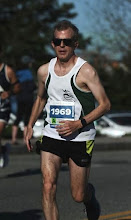
Ahh, year’s end, that time when many reminisce the good and lament the bad of times past, and makes promises for times forward. How dull. Let’s not do that. Instead, just one pop back in time, a peek forward, and let’s be done with it.
A couple weeks back I had the opportunity to haunt my alma mater, dear old RPI, or, as the politically and market correct types would now prefer you to say, Rensselaer. I had a meeting a few miles down the road on a mid-day Friday, and afterward, with the prospect of nothing but windshield in front of me for the next few hours, I elected to make hay of the remaining rare solstice daylight. I popped into the far corner of a parking lot, transformed from Meeting Man into Running Tights Man, and headed for campus.
I hadn’t been back in quite a few years, and I hadn’t run on campus since my First Lap days. Even then I’m not sure I ever did the campus tour on fleet foot. The idea just seemed cool, somehow, so in the midst of glum students trudging through finals week, off I set on a trail of memories.
How many times had I made that same trudge over the footbridge crossing 15th Street? The truth? Plenty, but fewer than I should have; my class attendance record wasn’t stellar. How many times through the wind tunnel of the walkway under the engineering center, now made longer and worse by the addition of a new building about the time of my departure? But save that new building, the main campus really hadn’t changed. Past the Holy Church of Computing – a gorgeous old “chapel”, or mini-cathedral as you prefer, transformed into the computing center, which had always struck me as odd – what kind of statement was that? Off the far reach of campus where the new media center, the only other big main campus addition, hung off the side of the hill like a bloated whale suspended high above Troy. Inside, I’m told it’s amazing. Outside, I can’t, even with great charity, compliment the architect.
As with any self-respecting college, RPI sits on a hill, indeed a pretty good sized one. Agony to the students, joy to a runner. After winding most of the way down to the bottom, Sage Avenue offered a great workout heading back up. Memories of the Troy garbage truck which lost its brakes on that hill and crushed a professor friend’s classic VW Beetle one sad day. A quick tour of the dorm area that was home for three years, then up the next hill to the field house, campus apartments, home for my last year, and up and above the massive new stadium. Troubling, in a way, that a school with such a focus on mental power has succumbed to mere athletics as an area of growth. But who am I to complain, when some of our best times back then were following our beloved hockey team, even if most of the players, or ‘pucks’ as we called them, were mostly undecided humanities majors lost amidst a sea of engineers? Indeed, I was one of three, yes, count ‘em, three students who made the thirty-hour marathon trip to catch a few games in Grand Forks, North Dakota. And I’ve never regretted it.
Back down the upper hill, past the wonderful campus church – nothing beats a college church, where only those who want to be there bother showing up – to finish up at the student union. The abused tables inside looked to be the same ones as when I left, but otherwise the place was a seriously brightened version of what I’d left behind.
Twenty five years since I left the place, save a few visits here and there. Seems like a lifetime, but in fact it’s only a third, or a quarter (if you’re lucky) of a lifetime. There are times I think that, approaching fifty (OK, still more than two years out), I’m “getting on” in years. Then I think of all that has transpired in the twenty five years since I left those undergrad haunts, and know that with reasonable self care and a bit of luck, chances are good I’ve got another twenty five before things really start going off the end of the steep slope. At least I hope. But presuming that to be the case, imagine how much is left to enjoy ahead!
I can’t stop the curve ball from left field. Just ask sis about that. But reasonable self care is what I can do to control that which is controllable. Even in my somewhat down state of coming off a year of injuries, the string of which isn’t over yet, I’m still in far better shape today than before I started running almost six years ago. And in that spirit, yesterday my wife and I signed up at a local gym; she for the workouts in general, me for the opportunity to finally put in some resistance and cross training. To kick it off, I ran the four and change to get down there today and put in half an hour working the upper body. I’ll hurt tomorrow, and feel good about it.
What will this time look like twenty five years from now?
29 December 2010


09 December 2010
Learning Who You Are
The tedious struggle to put my body back into one uncracked piece continues. It’s two months since I started taking time off to let the might-be-a-stress-fracture-might-not-but-umm-who-knows leg heal. After four weeks, it still felt injured. After two more weeks, not much better. I am now, perhaps foolishly, lightly hitting four a day with little discomfort – but not zero discomfort – on the theory that since rest didn’t heal it, why rest? Perhaps more time would do it, but I need some fitness and I need to burn off the five pounds that adhered rapidly to my mid-section during the break. So I’m treading the thin line and saying my prayers.
Four to six weeks off is enough time to get you out of the daily mode of getting in your workout. Sadly, no, I don’t cross train, though I know I should and am looking into a gym, but for now, four to six weeks off is, well, four to six weeks off. But as I’ve written in the past, running is part of the definition of who I am. I know that. I know it always will be, even if there are big breaks. Twenty years off didn’t kill that. A few more weeks, a few months, even a few years, if it came to that, won’t – I hope – kill that.
While these thoughts were knocking around in my head, I spent a day in the car with a co-worker traveling to an out-of-town appointment; the typical ‘drive for eight hours, see the customer for one’ kind of day we sometimes in endure in our business. But it was a great day as he too is an avid runner, so the conversation was lively, and – talk about bonus material – he’s a runner who also writes a blog. I bring this up not only because I find his writing enjoyable, but because of a particular article he told me about during that long slog through Vermont. It’s all about knowing who you are, knowing that you’re a runner. It’s here and well worth a read. After, of course, you’ve finished reading my article first.
By adulthood, we think we’ve figured out who we are. But have we? Do we really know what defines us? What we can do? I’d suggest that we do have a pretty good idea what defines us, and part of what defines us as runners is that we understand that we probably don’t really know what we’re capable of. We know that we will test ourselves and constantly try to answer that question.
 Which, in a circumspect way, brings me to my kids. Not my own kids, per se, but the kids I coach at my daughter’s middle school. (The sharp eyed among you may have detected that previous references to my daughters’ middle school have now shifted to my daughter’s middle school, since older daughter has moved on to high school leaving but one in the middle school, and yes, I am a charter member of the Eat Shoots and Leaves Militant Apostrophe Usage Goon Squad. But I digress.) At their age, they really don’t know who they are. They don’t define themselves as runners. They don’t know what they can do, and for the most part they don’t know the self-lifting power of testing themselves to find out. In two short months, starting at ground zero and seeing them only two or three times a week, I can’t turn them into lean, mean, running machines, but I can try to get them to explore the dimension of testing themselves.
 In the past several years, cross country at Immaculate Conception School has become cool. How cool? So cool that over a third of the eligible kids ran on the team this year. So cool that the school administrators let the kids leave their school uniforms at home on a meet day and wear their cross country jerseys instead. So cool that we even snagged a couple of the cheerleaders onto the cross country team this year. Memories of ‘Revenge of the Nerds’ come to mind.
When better than a third of the kids are on the team, you’re going to have plenty who don’t land in the same chapter with the word fast. Plenty who are taking a walk break before the half-mile mark. And plenty who are there for the social aspect. But it doesn’t matter because they’re out there, rather than at the mall or in front of the video game console.
Designing workouts is challenging when for some of them, motivation flags after a couple of quarter-mile sprints, so I try to instill from day one that the only competitor that matters is themselves. Let’s face it, with a school of two hundred kids from pre-K to eighth grade, it’d take a miracle to get the depth needed to win a lot of meets (though being a Catholic school, we can hope that our Miracle Applications do at least get reviewed upstairs). So why focus on beating the other guys? Just beat yourself.
And this year, they really did it. But not by just edging a few seconds off here or there. A few of the kids, and yes, I have to boast, my daughter was one of them, redefined themselves. It was clear that a lot of these kids saw themselves as slow. It never crossed their mind that they might be anything else. Then, a lot of them figured out they didn’t have to define themselves that way.
I watched at one meet as the gun went off and a good-sized chunk of our team lumbered out for a jog, well behind within fifty yards. By the end, many had picked their way to mid-pack. They weren’t slow. They just thought they were. I had to step out of character and chide them afterwards – always a dangerous thing to do with the fragile motivation of middle schoolers – and remind them that the race starts when the gun goes off.
By season end, many of the kids were running minutes – even up to five minutes – per mile faster pace than where they started. Not improvement, but redefinition. Going from fifteen minute pace, barely more than a quick walk, to nines, isn’t just an improvement, it’s recognizing that you’re capable of running when you didn’t think you could before. Dropping from a nine-to-ten minute jog to the sevens means you’ve learned how to race. Or better, learned that you can race. I recognize that because I’ve felt it. That day at Bay State, when at mile twenty-three, my companion told me to speed up and it dawned on me that a marathon didn’t have to just be endured but could actually be raced. Like that, these kids were having Eureka! moments.
Late in the season, my star protégé from last year, who this year as a high-school freshman is burning up the courses on his varsity team, dropped in to visit his old team. Always the silent giant, I goaded him into making a few comments to the team. He focused on that message that I’d drilled in so many times: You just don’t know what you’re capable of. Varsity gave him a new level of challenging, and again he was finding out.
By testing themselves, my kids learned a little about who they weren’t, and a little more about who they were, or at least who they could be. For any coach, amateur or pro, that’s a big check mark in the job satisfaction category. For any runner, it’s one of the reasons we love the sport.
Four to six weeks off is enough time to get you out of the daily mode of getting in your workout. Sadly, no, I don’t cross train, though I know I should and am looking into a gym, but for now, four to six weeks off is, well, four to six weeks off. But as I’ve written in the past, running is part of the definition of who I am. I know that. I know it always will be, even if there are big breaks. Twenty years off didn’t kill that. A few more weeks, a few months, even a few years, if it came to that, won’t – I hope – kill that.
While these thoughts were knocking around in my head, I spent a day in the car with a co-worker traveling to an out-of-town appointment; the typical ‘drive for eight hours, see the customer for one’ kind of day we sometimes in endure in our business. But it was a great day as he too is an avid runner, so the conversation was lively, and – talk about bonus material – he’s a runner who also writes a blog. I bring this up not only because I find his writing enjoyable, but because of a particular article he told me about during that long slog through Vermont. It’s all about knowing who you are, knowing that you’re a runner. It’s here and well worth a read. After, of course, you’ve finished reading my article first.
By adulthood, we think we’ve figured out who we are. But have we? Do we really know what defines us? What we can do? I’d suggest that we do have a pretty good idea what defines us, and part of what defines us as runners is that we understand that we probably don’t really know what we’re capable of. We know that we will test ourselves and constantly try to answer that question.
 Which, in a circumspect way, brings me to my kids. Not my own kids, per se, but the kids I coach at my daughter’s middle school. (The sharp eyed among you may have detected that previous references to my daughters’ middle school have now shifted to my daughter’s middle school, since older daughter has moved on to high school leaving but one in the middle school, and yes, I am a charter member of the Eat Shoots and Leaves Militant Apostrophe Usage Goon Squad. But I digress.) At their age, they really don’t know who they are. They don’t define themselves as runners. They don’t know what they can do, and for the most part they don’t know the self-lifting power of testing themselves to find out. In two short months, starting at ground zero and seeing them only two or three times a week, I can’t turn them into lean, mean, running machines, but I can try to get them to explore the dimension of testing themselves.
 In the past several years, cross country at Immaculate Conception School has become cool. How cool? So cool that over a third of the eligible kids ran on the team this year. So cool that the school administrators let the kids leave their school uniforms at home on a meet day and wear their cross country jerseys instead. So cool that we even snagged a couple of the cheerleaders onto the cross country team this year. Memories of ‘Revenge of the Nerds’ come to mind.
When better than a third of the kids are on the team, you’re going to have plenty who don’t land in the same chapter with the word fast. Plenty who are taking a walk break before the half-mile mark. And plenty who are there for the social aspect. But it doesn’t matter because they’re out there, rather than at the mall or in front of the video game console.
Designing workouts is challenging when for some of them, motivation flags after a couple of quarter-mile sprints, so I try to instill from day one that the only competitor that matters is themselves. Let’s face it, with a school of two hundred kids from pre-K to eighth grade, it’d take a miracle to get the depth needed to win a lot of meets (though being a Catholic school, we can hope that our Miracle Applications do at least get reviewed upstairs). So why focus on beating the other guys? Just beat yourself.
And this year, they really did it. But not by just edging a few seconds off here or there. A few of the kids, and yes, I have to boast, my daughter was one of them, redefined themselves. It was clear that a lot of these kids saw themselves as slow. It never
 crossed their mind that they might be anything else. Then, a lot of them figured out they didn’t have to define themselves that way.
I watched at one meet as the gun went off and a good-sized chunk of our team lumbered out for a jog, well behind within fifty yards. By the end, many had picked their way to mid-pack. They weren’t slow. They just thought they were. I had to step out of character and chide them afterwards – always a dangerous thing to do with the fragile motivation of middle schoolers – and remind them that the race starts when the gun goes off.
By season end, many of the kids were running minutes – even up to five minutes – per mile faster pace than where they started. Not improvement, but redefinition. Going from fifteen minute pace, barely more than a quick walk, to nines, isn’t just an improvement, it’s recognizing that you’re capable of running when you didn’t think you could before. Dropping from a nine-to-ten minute jog to the sevens means you’ve learned how to race. Or better, learned that you can race. I recognize that because I’ve felt it. That day at Bay State, when at mile twenty-three, my companion told me to speed up and it dawned on me that a marathon didn’t have to just be endured but could actually be raced. Like that, these kids were having Eureka! moments.
Late in the season, my star protégé from last year, who this year as a high-school freshman is burning up the courses on his varsity team, dropped in to visit his old team. Always the silent giant,
 I goaded him into making a few comments to the team. He focused on that message that I’d drilled in so many times: You just don’t know what you’re capable of. Varsity gave him a new level of challenging, and again he was finding out.
By testing themselves, my kids learned a little about who they weren’t, and a little more about who they were, or at least who they could be. For any coach, amateur or pro, that’s a big check mark in the job satisfaction category. For any runner, it’s one of the reasons we love the sport.
27 November 2010
First to Last
If you’re going to jump off a cliff, you might as well make it a high one and make the leap effective. After all, what’s the point of simply breaking a leg or something? Do it right, do it big. And so two months after my first win at the Forrest 5K, I crossed the line (almost) dead last at the Thanksgiving Day Pie & Glove 5K in Corning, New York. First to last in two months flat. Except this really was no cliff jump, this was a triumph.
The bad news is that I didn’t run it. Couldn’t, really. The pesky leg injury that I’d so hoped was healed in my last post in fact hasn’t healed. A few short test runs back in mid-month convinced me that yet more time is needed. They also worried me that those few short test runs may have re-injured or at least somewhat set back the healing. Maybe medical technology does need to be engaged at some point here, if for no other reason than to put a definition on the length of the break I need to be whole again.
But having running off the table didn’t have to take this new family tradition off the table. I elected to walk it instead with sis, who just a week earlier had wrapped up months of treatment – surgery, chemo, and radiation – in her battle with breast cancer. She’s kept a positive outlook through the whole fight, and while I know this will make her blush a bit, I’ll say it because it’s true: she’s set a fine example of how to take on this tough challenge. And what better way to cap off what we hope is her victorious fight than by getting out there on the roads and covering the distance. Speed didn’t matter. I was proud to walk with her. And of course I let her – and my wife – beat me across the line.
All that being said, this was a new way to do a race, and it was, quite frankly, a lot of fun. No fretting about what to wear. It was cold, windy, and snowing lightly, so just bundle up. Who cares about performance clothing? In fact, I don’t think I’ve ever had more race-specific clothing on at one time ever, not to mention in a race. Lessee, Stu’s 30K t-shirt (cotton, of course!), Reach the Beach hat, Boston Marathon jacket, Central Mass Striders gloves… I was a walking billboard. In blue jeans. Yep, race gear!
 No fretting about arriving in time to warm up, hit the porta-johns, suck down a Gu, no fretting at all. We showed up about thirteen minutes before the gun, grabbed our numbers and high quality gloves (it is, after all, the Pie and Glove, and yes, you do get gloves), and wandered to the back of the pack.
The gun? Oh yeah, sure, whatever. Let’s go for a stroll. With numbers pinned on us. Kind of silly in a way, but let’s face it, the weather wasn’t so great and without those numbers sitting down on the pre-registration table with our names on them, we might well have stayed home. Instead, though it wasn’t a run, it was still a good bit of mild exercise and a fine dose of guilt alleviation for the coming feast.
And we chatted. And wandered. And watched all the people running when the course doubled on itself. And had a fine time.
 At one point sis asked what I thought of all those people struggling to finish a race at the back of the pack. That’s easy. I hold them in the highest respect. They’re not on the couch. They’re out there. Speed simply doesn’t matter. And frankly, I certainly don’t want to be on a marathon course for five or six hours – they’ve got to be respected for their determination.
But on this day I was behind all of them – about eight hundred of them – save five or so walking behind us. So what? Sis, we believe, and we pray, has beaten cancer, and walked 5K at a decent pace to prove it. Hats off to her (at least when we got back inside and it was warm enough to take our hats off).
I am, however, going to have to hold her to her promise to run it next Thanksgiving.
The bad news is that I didn’t run it. Couldn’t, really. The pesky leg injury that I’d so hoped was healed in my last post in fact hasn’t healed. A few short test runs back in mid-month convinced me that yet more time is needed. They also worried me that those few short test runs may have re-injured or at least somewhat set back the healing. Maybe medical technology does need to be engaged at some point here, if for no other reason than to put a definition on the length of the break I need to be whole again.
But having running off the table didn’t have to take this new family tradition off the table. I elected to walk it instead with sis, who just a week earlier had wrapped up months of treatment – surgery, chemo, and radiation – in her battle with breast cancer. She’s kept a positive outlook through the whole fight, and while I know this will make her blush a bit, I’ll say it because it’s true: she’s set a fine example of how to take on this tough challenge. And what better way to cap off what we hope is her victorious fight than by getting out there on the roads and covering the distance. Speed didn’t matter. I was proud to walk with her. And of course I let her – and my wife – beat me across the line.
All that being said, this was a new way to do a race, and it was, quite frankly, a lot of fun. No fretting about what to wear. It was cold, windy, and snowing lightly, so just bundle up. Who cares about performance clothing? In fact, I don’t think I’ve ever had more race-specific clothing on at one time ever, not to mention in a race. Lessee, Stu’s 30K t-shirt (cotton, of course!), Reach the Beach hat, Boston Marathon jacket, Central Mass Striders gloves… I was a walking billboard. In blue jeans. Yep, race gear!
 No fretting about arriving in time to warm up, hit the porta-johns, suck down a Gu, no fretting at all. We showed up about thirteen minutes before the gun, grabbed our numbers and high quality gloves (it is, after all, the Pie and Glove, and yes, you do get gloves), and wandered to the back of the pack.
The gun? Oh yeah, sure, whatever. Let’s go for a stroll. With numbers pinned on us. Kind of silly in a way, but let’s face it, the weather wasn’t so great and without those numbers sitting down on the pre-registration table with our names on them, we might well have stayed home. Instead, though it wasn’t a run, it was still a good bit of mild exercise and a fine dose of guilt alleviation for the coming feast.
And we chatted. And wandered. And watched all the people running when the course doubled on itself. And had a fine time.
 At one point sis asked what I thought of all those people struggling to finish a race at the back of the pack. That’s easy. I hold them in the highest respect. They’re not on the couch. They’re out there. Speed simply doesn’t matter. And frankly, I certainly don’t want to be on a marathon course for five or six hours – they’ve got to be respected for their determination.
But on this day I was behind all of them – about eight hundred of them – save five or so walking behind us. So what? Sis, we believe, and we pray, has beaten cancer, and walked 5K at a decent pace to prove it. Hats off to her (at least when we got back inside and it was warm enough to take our hats off).
I am, however, going to have to hold her to her promise to run it next Thanksgiving.
12 November 2010
Fractured, of a Sort
I’ve let you down, I know. All eight of you (I’m being optimistic). Never before have I put such a fracture in my writing schedule, and I hope to not do so again. But I blame this fracture on what else – ? – a fracture. Of a sort, or so I think. Not that I deserve an excuse. Fracture or not, there’s been plenty to write about, even ignoring the national embarrassment of the tea party, topics which I’ll try to visit in the next few weeks. But I’ll claim an excuse anyway.
One aspect of the Walk-On Marathon I neglected to mention in my last posting long, long ago was the Magic Shoes. Ironically, while tooling down the highway earlier today, I was listening to one of Chris Russell’s podcasts where he addressed the question of whether to wear racing flats in a marathon. His answer, completely logical, was, “Not if you haven’t tried them on a long run before.”
Of course, common sense says don’t change anything on race day. I know that wisdom well, but did exactly that last month: changed something on race day, and specifically, ran it in the racing flats, or in my case, the near-racing flats, the frighteningly yellow and gloriously airy New Balance 904s. A bad idea if I’d been racing, but as I’ve said, the New Hampshire Marathon was anything but a race for me, and knowing that going in made it a fine time to test out the idea of wearing racing flats for 26 miles – racing flats I’d never worn out of the lower half of single digit mileage. But racing flats that had – perhaps – helped me win the Forrest 5K with their liberating lightness, and which might possibly help carry a hopelessly undertrained old fart through an unlikely marathon.
And they were great from the standpoint of perceptible reduced mass, though being considerably less meaty than my usual tires, I fully expected more foot fatigue than usual. I was not disappointed. Or at least I was not wrong. By twenty miles in, yes, my feet weren’t too happy. But then again, neither was the rest of me, so the experiment was inconclusive. On the other hand, my leg injury was completely silent all day. On the third hand, my knees were uncharacteristically tender. Was it the shoes? Hung jury on all counts.
What was conclusive was that while the leg didn’t hurt that day, when I hit the roads a few days later, it was unmistakably uncomfortable. Having nursed this particular wound since late August, having gotten through the marathon that really wasn’t supposed to have been, and having no big events on the schedule in the near future, I made the command decision that I was, in fact, riding a stress fracture and that it was time to heal. The fact that my knees were sore as hell made the call considerably easier. Maybe the shoes contributed to making it easier to make that decision. God works in weird ways.
It was pretty tough deciding to take a solid month off for an undiagnosed injury. I don’t like taking two days off consecutively, let alone a week, let alone – a month? A break longer than any since the surgery? Having not seen a doctor?
Truth is, if there is pain in the middle of your shin, your choices are pretty limited. Shin splints, stress fracture, or alien intervention. While I can’t rule out the latter, the remedies for the first two are pretty much the same: rest. The only difference would be the duration of said rest, and it is of course frustrating to not be certain, but the reality is that I could spend a lot of money and time to see doctors, get a bone scan, await results which would probably be inconclusive. Been there several years ago, done that, got the chance to watch radioactive atoms die on my behalf, lighting up the monitor with a cool image of my bones, but still didn’t really know in the end… And the answer will be? Rest. And by the time all of this medical wonder was done, I would have already spent a lot of time at… Rest. So why be American? Why throw money and medical technology at something that will, if rested, heal; something that there’s really nothing else to do about anyway?
Penning my name on the Injured Reserve list meant giving up my publicly unspoken but very real goal of a two thousand mile year. I’d been on track through the first half of the year, and while I’d fallen a bit behind through the summer of injuries, said goal was still within reach. I’ve had my eyes on that one for a number of years, but something has always gotten in the way. And so it would be again.
I tell the kids I coach that you can’t worry about running tomorrow or next week; you need to worry about being able to run next year and through the next decade. It’s good advice, but like most good advice easier to give than to live by. This has been a good exercise in chugging a bottle of my own medicine.
Four weeks. Uncharacteristic guilt in eating. Crabbiness, just ask my wife. Fear that every little jog – casually across the field while coaching my middle school cross country team, across the parking lot in a hurry, and so on – would cause re-injury. And the irony and insult of traveling to my company’s annual sales meeting in Hell (er, I mean, Las Vegas) and in the first hour upon arrival running into three colleagues telling me that this year they’d brought their running gear to run with me…and I can’t. Just about killed me.
And then the angst, is four weeks enough? At t-plus four weeks, I hit the roads for a test jaunt, and still felt a twang in the shin. Harmless test? Or would that reset the clock? Another four weeks? Please, no!
Another week, another road test, this time no pain. Hope. And a few days later, a trail run with one of those colleagues I’d had to deny in Vegas, trails being ostensibly gentler than roads but in truth, this being New England where we grow rocks for fun and profit, not. And in the last quarter mile, a twang. Oh miserable angst. Say it ain’t so.
Tomorrow I’ll give it another roll and see how the dice land. It’s just going to be dicey for a while. I just keep telling myself that a fracture in my training is a blip. While I’d like to be running next week, I’d rather be running next year and next decade.
One aspect of the Walk-On Marathon I neglected to mention in my last posting long, long ago was the Magic Shoes. Ironically, while tooling down the highway earlier today, I was listening to one of Chris Russell’s podcasts where he addressed the question of whether to wear racing flats in a marathon. His answer, completely logical, was, “Not if you haven’t tried them on a long run before.”
Of course, common sense says don’t change anything on race day. I know that wisdom well, but did exactly that last month: changed something on race day, and specifically, ran it in the racing flats, or in my case, the near-racing flats, the frighteningly yellow and gloriously airy New Balance 904s. A bad idea if I’d been racing, but as I’ve said, the New Hampshire Marathon was anything but a race for me, and knowing that going in made it a fine time to test out the idea of wearing racing flats for 26 miles – racing flats I’d never worn out of the lower half of single digit mileage. But racing flats that had – perhaps – helped me win the Forrest 5K with their liberating lightness, and which might possibly help carry a hopelessly undertrained old fart through an unlikely marathon.
And they were great from the standpoint of perceptible reduced mass, though being considerably less meaty than my usual tires, I fully expected more foot fatigue than usual. I was not disappointed. Or at least I was not wrong. By twenty miles in, yes, my feet weren’t too happy. But then again, neither was the rest of me, so the experiment was inconclusive. On the other hand, my leg injury was completely silent all day. On the third hand, my knees were uncharacteristically tender. Was it the shoes? Hung jury on all counts.
What was conclusive was that while the leg didn’t hurt that day, when I hit the roads a few days later, it was unmistakably uncomfortable. Having nursed this particular wound since late August, having gotten through the marathon that really wasn’t supposed to have been, and having no big events on the schedule in the near future, I made the command decision that I was, in fact, riding a stress fracture and that it was time to heal. The fact that my knees were sore as hell made the call considerably easier. Maybe the shoes contributed to making it easier to make that decision. God works in weird ways.
It was pretty tough deciding to take a solid month off for an undiagnosed injury. I don’t like taking two days off consecutively, let alone a week, let alone – a month? A break longer than any since the surgery? Having not seen a doctor?
Truth is, if there is pain in the middle of your shin, your choices are pretty limited. Shin splints, stress fracture, or alien intervention. While I can’t rule out the latter, the remedies for the first two are pretty much the same: rest. The only difference would be the duration of said rest, and it is of course frustrating to not be certain, but the reality is that I could spend a lot of money and time to see doctors, get a bone scan, await results which would probably be inconclusive. Been there several years ago, done that, got the chance to watch radioactive atoms die on my behalf, lighting up the monitor with a cool image of my bones, but still didn’t really know in the end… And the answer will be? Rest. And by the time all of this medical wonder was done, I would have already spent a lot of time at… Rest. So why be American? Why throw money and medical technology at something that will, if rested, heal; something that there’s really nothing else to do about anyway?
Penning my name on the Injured Reserve list meant giving up my publicly unspoken but very real goal of a two thousand mile year. I’d been on track through the first half of the year, and while I’d fallen a bit behind through the summer of injuries, said goal was still within reach. I’ve had my eyes on that one for a number of years, but something has always gotten in the way. And so it would be again.
I tell the kids I coach that you can’t worry about running tomorrow or next week; you need to worry about being able to run next year and through the next decade. It’s good advice, but like most good advice easier to give than to live by. This has been a good exercise in chugging a bottle of my own medicine.
Four weeks. Uncharacteristic guilt in eating. Crabbiness, just ask my wife. Fear that every little jog – casually across the field while coaching my middle school cross country team, across the parking lot in a hurry, and so on – would cause re-injury. And the irony and insult of traveling to my company’s annual sales meeting in Hell (er, I mean, Las Vegas) and in the first hour upon arrival running into three colleagues telling me that this year they’d brought their running gear to run with me…and I can’t. Just about killed me.
And then the angst, is four weeks enough? At t-plus four weeks, I hit the roads for a test jaunt, and still felt a twang in the shin. Harmless test? Or would that reset the clock? Another four weeks? Please, no!
Another week, another road test, this time no pain. Hope. And a few days later, a trail run with one of those colleagues I’d had to deny in Vegas, trails being ostensibly gentler than roads but in truth, this being New England where we grow rocks for fun and profit, not. And in the last quarter mile, a twang. Oh miserable angst. Say it ain’t so.
Tomorrow I’ll give it another roll and see how the dice land. It’s just going to be dicey for a while. I just keep telling myself that a fracture in my training is a blip. While I’d like to be running next week, I’d rather be running next year and next decade.
06 October 2010
Walk-On Marathon
[ Ed. Note: Yes, it’s another marathon-length marathon story. They are marathons, after all, right? If I could endure the race, you can endure the article! ]
My club-mate Bill (photo at the end), who lit me up on the forty-dollar New Hampshire Marathon, and whom I can blame for this whole adventure (or better, thank), described my participation in this race as a “walk-on marathon”. I think he got it right, so long as I add, “walk lots” as well.
Admittedly, I was ridiculously casual about this race. It’s not like I’m not in shape compared to the general populace, but I certainly wasn’t in shape for a marathon, at least not what I consider marathon shape. But I really didn’t worry about it. After all, after my summer of injuries, I wasn’t going to do a marathon this fall anyway. Then, enter Bill’s idea of the forty-dollar marathon, which to me was an easy price to pay for the motivation that a looming race will bring. If you don’t run, if you lose it, who cares? Forty bucks!
 As for the motivation, it worked. But my body got in the way of consummating that motivation. This was a crash training program if ever there was one, and in the end, I crashed. After putting in a seventeen miler of only moderate strength a few weeks back, I knew I needed another long one, twenty minimum, twenty two preferred, to be anywhere close to ready. Instead, I spent the last two weeks barely running, save that sweet win at the Forrest 5K and some light workouts with the cross country team I coach, rather certain that I had at least half of a stress fracture. No long run, no certainty that things wouldn’t go snap, crackle, pop at some point. Now there’s a way to head into a marathon. What, are you crazy?
Well, yes, of course, but not that crazy. Those two weeks of rest gave me some relief from the pain and a reasonable confidence that my skeletal structure would hold up. So since I really didn’t care how fast or slow I ran the race (which is what I said publicly, but to an obsessive like me, that’s a bald-face lie; suffice to say this was as close as I could get to not caring), off I went to Bristol, New Hampshire for the fun. When asked my goal for the race, I simply answered, “Finish without anything breaking.” Simple goal. Walk on. Run marathon. Return in one piece.
After days of the remnants of a tropical storm passing through, Saturday dawned utterly gorgeous; brilliant sunshine, crisp air around fifty degrees, even a few bits of foliage not stripped from the trees by the passing storm. Gorgeous yes, but not perfect. Windy as all get up. Wicked windy. Nasty windy. And that ingredient, mixed with a wonderfully hilly course and my astoundingly fabulous training regimen, this walk-on marathon turned into one of the toughest I’ve run.
I’ll jump ahead here and tell you I loved this race. I love small town races in general. I love the attention from the staff from the race director on down, the casual atmosphere, the easy logistics. The folks working the finish line, med tent, and goodie table afterwards were all wonderful. The one-man band belting out Sweet Home Chicago as I was recovering from the finish line woozies – and though being helped to walk it off by a staffer, able to dance and sing along enough to give everyone a good laugh – was a perfect ending treat. And the folks at the water table at Shackett’s Market at mile twenty three, where I simply had to return afterward to bring home some famous homemade donuts to the home clan, were a joy to chat with. My thanks go out to all of them.
I say this ahead of time so you know that I’m not grousing about the imperfections. They come with the territory in small town races, and you accept them and enjoy anyway. And a typical imperfection – inconsistent mileposts – surfaced quickly. Sure, it was a hilly course, and yes, as noted, the wind was wicked and wild, but the variations that kept popping up on my mile splits were pretty hard to correlate to course conditions, which meant that I really wasn’t sure what I was running, whether I was being foolish, dog-slow, or what was really happening to my pace in the high miles with splits all over the map (see chart). Not that it really mattered, but it made it more interesting, more mysterious. And my suspicion was verified in the second half, where I found the distance between the half-marathon mileposts (which started out near the turnaround point) and the full marathon mileposts, which should have been a consistent tenth of a mile, varied considerably. Small town race. Loved it. Enjoy anyway.
To appreciate this adventure you have to visualize the course. It starts with two miles uphill, rising north out of Bristol, and continues north up the east side of Newfound Lake. There are plenty of sweet views across this gem of a lake, but few views of flatness other than the surface of the water. At eight and a half, it leaves the main road to cut west across the northern edge of the lake, and in doing so traverses the hilliest section, a series of jolts that include some Franconia-style painful downhills. Passing through a spot that can only evoke the word, “lovely”, Hebron Common, it hits an out & back to Sculpted Rocks, a cool geological oddity which we checked out on our drive-the-course tour back in August. Passing through Hebron again, one is treated to another significant collection of hills heading south along the west side of the lake before closing the loop and re-connecting to the outbound route to drop the last two miles back into Bristol.
Now apply that to the day at hand. Hills, hills, and more hills, and a stiff wind from the northwest. Nine miles north, a preponderance of uphill, and entirely into the wind. Despite per-mile variations induced by unpredictable mileposts, on average running sevens, not wicked fast, but not bad considering my awful training, quasi-injured state, and the conditions. The wind, the incessant wind. I’m churning north, longing for the turn, thinking I’ll be out of the wind…
Now, the astute among you are saying, “But wait a minute, you said it was a stiff wind out of the northwest, and you told me the course turned to the west.”
You’re smarter than I was. For some reason I was convinced that once we turned off the main drag, we’d be out of the wind. No accounting for lack of brains here. Maybe it was those pesky endorphins interfering with logic? In any event, we turned off at eignt-point-something, and turned west, smack into the wind again.
I should make a minor correction here. When I say we turned off, I’m exaggerating a bit. This was a small race, two hundred forty, and the lead ranks were sparse. Translation: It was a lonely race. After a couple of brief stints with companions in the early miles, by seven or so it was me, the howl of the wind, and an occasional spectator. I was in tenth place, and in tenth I would stay until seventeen. If not for the out & back section, where I got a view of the nine in front and a good deal of the field behind, it would have been lonelier still.
 Thus followed a headwind struggle clear to the turnaround at Sculpted Rocks, fourteen miles in. And mile fourteen tossed in a nasty climb, to boot. But once the turn was made, watch out! Downhill, downwind, down went the pace. Man, those folks running the half marathon, which started up near the turnaround spot, had a heck of a day with a full-race-long windy kick in the pants. But of course I wasn’t running the half. Life just isn’t fair sometimes.
The wind carried me into the high teens, and then it was pretty much over. Having not run more than seventeen since Boston, it was pretty much a foregone conclusion what would happen. I was just pleased it held off as long as it did; after all, my calves had been threatening to cramp since ten. Before I hit eighteen, the fatigue set in and I started taking 40-second walk breaks, which surprisingly didn’t balloon my pace that badly, as I was still making good steam while running. Knowing the last two miles were downhill to Bristol, I told myself it was only a race to twenty four, then a free ride. By twenty three, the walk breaks stretched to 60-seconds and the miles came agonizingly slower, bursting over the eight-minute barrier, pushing nines. Twenty four finally arrived, and the downhill began, but cruelly brought little relief. Twenty six needed two walk breaks, the second coming when the woozies hit. After Wineglass, I simply don’t play games with the woozies. So what if a mile goes over nine? Beats a broken nose.
How is it we marathoners can endure such agony and leave with such great memories? There’s no denying that the last thirty minutes, no, perhaps even the last forty-five minutes of this race were awful. But I loved this race.
Somehow despite the extended eight-mile-long mighty struggle phase, I managed to lose only four places, landing fourteenth, and fourth master, though since the first master was second overall and took a top-three award, I scored the third-place master spot. Walk on, medal, go figure. And so marathon number twelve is in the books. Of my twelve, this was my fourth slowest at 3:15:56, but completely satisfying nonetheless. It wasn’t pretty; indeed, it was downright ugly in the high miles, but I walked on and turned in a Boston qualifier for 2012 (with fifteen minutes to spare, in case they tighten the requirements), taking the pressure off for next year.
And the funny thing is that the leg about which I was so worried never spoke up throughout the entire race, not even in the ugly high miles where all efforts at holding any sort of form degraded to total junk. It never hurt a whit after the race. A couple of days later I can feel it a bit, but it really does feel better than before (though yes, I will rest it now). Apparently medical science has found a new cure for injuries. Beat them silly.
My club-mate Bill (photo at the end), who lit me up on the forty-dollar New Hampshire Marathon, and whom I can blame for this whole adventure (or better, thank), described my participation in this race as a “walk-on marathon”. I think he got it right, so long as I add, “walk lots” as well.
Admittedly, I was ridiculously casual about this race. It’s not like I’m not in shape compared to the general populace, but I certainly wasn’t in shape for a marathon, at least not what I consider marathon shape. But I really didn’t worry about it. After all, after my summer of injuries, I wasn’t going to do a marathon this fall anyway. Then, enter Bill’s idea of the forty-dollar marathon, which to me was an easy price to pay for the motivation that a looming race will bring. If you don’t run, if you lose it, who cares? Forty bucks!
 As for the motivation, it worked. But my body got in the way of consummating that motivation. This was a crash training program if ever there was one, and in the end, I crashed. After putting in a seventeen miler of only moderate strength a few weeks back, I knew I needed another long one, twenty minimum, twenty two preferred, to be anywhere close to ready. Instead, I spent the last two weeks barely running, save that sweet win at the Forrest 5K and some light workouts with the cross country team I coach, rather certain that I had at least half of a stress fracture. No long run, no certainty that things wouldn’t go snap, crackle, pop at some point. Now there’s a way to head into a marathon. What, are you crazy?
Well, yes, of course, but not that crazy. Those two weeks of rest gave me some relief from the pain and a reasonable confidence that my skeletal structure would hold up. So since I really didn’t care how fast or slow I ran the race (which is what I said publicly, but to an obsessive like me, that’s a bald-face lie; suffice to say this was as close as I could get to not caring), off I went to Bristol, New Hampshire for the fun. When asked my goal for the race, I simply answered, “Finish without anything breaking.” Simple goal. Walk on. Run marathon. Return in one piece.
After days of the remnants of a tropical storm passing through, Saturday dawned utterly gorgeous; brilliant sunshine, crisp air around fifty degrees, even a few bits of foliage not stripped from the trees by the passing storm. Gorgeous yes, but not perfect. Windy as all get up. Wicked windy. Nasty windy. And that ingredient, mixed with a wonderfully hilly course and my astoundingly fabulous training regimen, this walk-on marathon turned into one of the toughest I’ve run.
I’ll jump ahead here and tell you I loved this race. I love small town races in general. I love the attention from the staff from the race director on down, the casual atmosphere, the easy logistics. The folks working the finish line, med tent, and goodie table afterwards were all wonderful. The one-man band belting out Sweet Home Chicago as I was recovering from the finish line woozies – and though being helped to walk it off by a staffer, able to dance and sing along enough to give everyone a good laugh – was a perfect ending treat. And the folks at the water table at Shackett’s Market at mile twenty three, where I simply had to return afterward to bring home some famous homemade donuts to the home clan, were a joy to chat with. My thanks go out to all of them.
I say this ahead of time so you know that I’m not grousing about the imperfections. They come with the territory in small town races, and you accept them and enjoy anyway. And a typical imperfection – inconsistent mileposts – surfaced quickly. Sure, it was a hilly course, and yes, as noted, the wind was wicked and wild, but the variations that kept popping up on my mile splits were pretty hard to correlate to course conditions, which meant that I really wasn’t sure what I was running, whether I was being foolish, dog-slow, or what
 was really happening to my pace in the high miles with splits all over the map (see chart). Not that it really mattered, but it made it more interesting, more mysterious. And my suspicion was verified in the second half, where I found the distance between the half-marathon mileposts (which started out near the turnaround point) and the full marathon mileposts, which should have been a consistent tenth of a mile, varied considerably. Small town race. Loved it. Enjoy anyway.
To appreciate this adventure you have to visualize the course. It starts with two miles uphill, rising north out of Bristol, and continues north up the east side of Newfound Lake. There are plenty of sweet views across this gem of a lake, but few views of flatness other than the surface of the water. At eight and a half, it leaves the main road to cut west across the northern edge of the lake, and in doing so traverses the hilliest section, a series of jolts that include some Franconia-style painful downhills. Passing through a spot that can only evoke the word, “lovely”, Hebron Common, it hits an out & back to Sculpted Rocks, a cool geological oddity which we checked out on our drive-the-course tour back in August. Passing through Hebron again, one is treated to another significant collection of hills heading south along the west side of the lake before closing the loop and re-connecting to the outbound route to drop the last two miles back into Bristol.
Now apply that to the day at hand. Hills, hills, and more hills, and a stiff wind from the northwest. Nine miles north, a preponderance of uphill, and entirely into the wind. Despite per-mile variations induced by unpredictable mileposts, on average running sevens, not wicked fast, but not bad considering my awful training, quasi-injured state, and the conditions. The wind, the incessant wind. I’m churning north, longing for the turn, thinking I’ll be out of the wind…
Now, the astute among you are saying, “But wait a minute, you said it was a stiff wind out of the northwest, and you told me the course turned to the west.”
You’re smarter than I was. For some reason I was convinced that once we turned off the main drag, we’d be out of the wind. No accounting for lack of brains here. Maybe it was those pesky endorphins interfering with logic? In any event, we turned off at eignt-point-something, and turned west, smack into the wind again.
I should make a minor correction here. When I say we turned off, I’m exaggerating a bit. This was a small race, two hundred forty, and the lead ranks were sparse. Translation: It was a lonely race. After a couple of brief stints with companions in the early miles, by seven or so it was me, the howl of the wind, and an occasional spectator. I was in tenth place, and in tenth I would stay until seventeen. If not for the out & back section, where I got a view of the nine in front and a good deal of the field behind, it would have been lonelier still.
 Thus followed a headwind struggle clear to the turnaround at Sculpted Rocks, fourteen miles in. And mile fourteen tossed in a nasty climb, to boot. But once the turn was made, watch out! Downhill, downwind, down went the pace. Man, those folks running the half marathon, which started up near the turnaround spot, had a heck of a day with a full-race-long windy kick in the pants. But of course I wasn’t running the half. Life just isn’t fair sometimes.
The wind carried me into the high teens, and then it was pretty much over. Having not run more than seventeen since Boston, it was pretty much a foregone conclusion what would happen. I was just pleased it held off as long as it did; after all, my calves had been threatening to cramp since ten. Before I hit eighteen, the fatigue set in and I started taking 40-second walk breaks, which surprisingly didn’t balloon my pace that badly, as I was still making good steam while running. Knowing the last two miles were downhill to Bristol, I told myself it was only a race to twenty four, then a free ride. By twenty three, the walk breaks stretched to 60-seconds and the miles came agonizingly slower, bursting over the eight-minute barrier, pushing nines. Twenty four finally arrived, and the downhill began,
 but cruelly brought little relief. Twenty six needed two walk breaks, the second coming when the woozies hit. After Wineglass, I simply don’t play games with the woozies. So what if a mile goes over nine? Beats a broken nose.
How is it we marathoners can endure such agony and leave with such great memories? There’s no denying that the last thirty minutes, no, perhaps even the last forty-five minutes of this race were awful. But I loved this race.
Somehow despite the extended eight-mile-long mighty struggle phase, I managed to lose only four places, landing fourteenth, and fourth master, though since the first master was second overall and took a top-three award, I scored the third-place master spot. Walk on, medal, go figure. And so marathon number twelve is in the books. Of my twelve, this was my fourth slowest at 3:15:56, but completely satisfying nonetheless. It wasn’t pretty; indeed, it was downright ugly in the high miles, but I walked on and turned in a Boston qualifier for 2012 (with fifteen minutes to spare, in case they tighten the requirements), taking the pressure off for next year.
And the funny thing is that the leg about which I was so worried never spoke up throughout the entire race, not even in the ugly high miles where all efforts at holding any sort of form degraded to total junk. It never hurt a whit after the race. A couple of days later I can feel it a bit, but it really does feel better than before (though yes, I will rest it now). Apparently medical science has found a new cure for injuries. Beat them silly.
30 September 2010
Bizarrely Beautiful
[ Ed note: This is the last of three articles on Reach the Beach. ]
Reach the Beach was a thirty-six hour blur. Between leaving home at 7:30 AM Friday to returning at 7:30 PM Saturday, I have to think hard and refer to paper records to remind myself of what happened at any given time. Not sleeping will do that to you. But one image is burned in my mind with intense clarity; an image that frames the entire experience, an image of bizarre beauty, and image that will be impossible to convey in words, but I’ll try.
How often do you see or experience something entirely apart from your previous experience? Visit a new place of sublime natural beauty? The mountains or dunes may be different, but you’ve seen beautiful vistas before. See a new movie, concert, or show? They may be new works, to be sure, but they are more or less new variations on familiar concepts. In general, once past our younger years, our ‘new’ experiences aren’t all that new. And you could argue that what I’m about to describe wasn’t all that new either, but it sure struck me as such.
To begin with, the whole idea of a string of runners spanning over fifty miles is pretty unique, but it’s not something you can take in all at once. Still, it makes an impression, as you drive for tens of hours through the day, through the night, never more than a minute or so from the next runner stretched out in a line before you. When darkness falls (Thud! …as I say to my daughters…) that line takes on an ethereal quality as the runners themselves vanish, replaced by bouncing blinky lights and the various shapes of reflective stripes worn by runners of various shapes. It’s like a fifty-mile-long stretched out line of Christmas lights, in a way.
My first shift came as blackness overtook day, and so my first vision of this was from road level. But that first shift was on a road with enough traffic, interrupting the placid red bobbing procession, making it interesting but not all that impressive. Subsequent shifts seen from the relative comfort of the van brought this home. And on the last shift of our van’s evening round, I got a preview of what would later burn into my head as the signature image of the event.
It was about 9:30 PM when our number twelve runner Bill took the baton at Echo Lake State Park, somewhere in the voids of central New Hampshire. Unique to this leg, the RTB Overlords aimed him out the back entrance of the park – a route he later described as utter darkness – while we motorized types used the main entrance and looped around to rejoin the course. Down the road we stopped for the usual mid-leg cheering, but for some reason this time it was really, really, really dark. And really, really quiet. And, odd for the area, flat and straight. And devoid of all traffic save a van now and then.
It left an impression. Standing in the road, it felt like an enveloping dark, punctuated only by the passing, every half minute or so, of a bobbing headlamp attached to a heavily breathing set of footsteps and blinky lights. Nothing but quiet, dark, and poetically lonely runners. Peaceful. And beautiful, in a way.
A peace unfortunately shattered by the frenetic activity and klieg lights of the net Vehicle Transition Area, my subsequent hopeless attempts to get some sleep during our van’s off-time, the rude 2:30 AM rising. We were back on the road again, my head in a semi-zombie state till 5 AM, when I found myself at the Gilmanton School – a town I’d never heard of – shivering from cold and my sleep-deprived body’s inability to regulate its temperature, itching to start my leg, my heart, my blood flow.
When the time came, it was somehow even darker than during our stop on Bill’s leg. The moon was supposed to be at half-phase, and though we didn’t see it during Bill’s phase, it probably raised the level of darkness from complete to merely utter. By 5 AM, it had set, and once away from the lights of the school, complete blackness pervaded, except, of course, the minute quanta of light that each runner’s lamps emitted.
When it’s dark enough, you realize that an LED headlamp burns with a cold super-white, almost blue-tinged light. You also realize that while the quantity of light it casts might be relatively small – certainly smaller than what you’d like when your goal is to illuminate on the road in front of you, the laws of physics are real, and if unimpeded, that light will go on effectively forever.
The air was cold, crisp, and indeed, optically unimpeding. The road, at this point, straight. The light did go on effectively forever. As I approached and passed each runner, the reflections it returned from their reflectors far outshone their blinky lights, but because the beam bobbed with each stride and sway of my head, the effect was almost strobe-like, somewhat magical, completely surreal. And then came the ‘wow’ moment.
The next runner I approached was wearing half tights and a form-fitting top, all black, nothing baggy waving in the breeze. On each arm, each leg, and in several other places, his togs had double sets of long thin silver-white reflective strips built in. Additionally, his reflective vest was snug, not prone to any spare movement, and his blinky light was built in. There was no stray movement in any clothing; all was completely coordinated with his body’s motion. Taken as a whole, in the cold harsh light of the LED, his black-clad body vanished into the night, replaced by a series of lights, mostly reflected, that perfectly, almost digitally, recorded his every movement. It was kind of a cross between the concept of those round measurement points painted all over a crash test dummy and a very funky computer-generated simulation of human movement. It was a way I’d never really seen a human before. A study in fluid movement. A study in form. Utterly unique. Utterly cool.
But there was another component which added to the effect. It was cold, in the high forties, dry, crisp, perfect steam weather. And so every second, this computer-generated motion study became a human steam locomotive, bursting a cloud of exhalation that blew up and over his head, capturing the cold light in a blast that appeared, roiled, and quickly vanished out of my beam. It too took on an almost artificial computer-generated quality.
The moment lasted for all of twenty to thirty seconds as I got close enough to get the full power of my beam on this vision, then just as rapidly evaporated as I passed him and moved on to my next prey. I’d pass plenty more runners on this leg, but none with that combination of clothing, form, motion, light, and steam; that power of impression. I’m certain he had no idea of the impact that his gear and the conditions had created. But for me it burned into my memory an image that somehow embodied the whole idea of Reach the Beach. Human form vanquishes all, including night, to carry on toward out goal.
Yeah, I suppose you had to be there. But trust me, bizarrely beautiful barely begins to describe it.
Reach the Beach was a thirty-six hour blur. Between leaving home at 7:30 AM Friday to returning at 7:30 PM Saturday, I have to think hard and refer to paper records to remind myself of what happened at any given time. Not sleeping will do that to you. But one image is burned in my mind with intense clarity; an image that frames the entire experience, an image of bizarre beauty, and image that will be impossible to convey in words, but I’ll try.
How often do you see or experience something entirely apart from your previous experience? Visit a new place of sublime natural beauty? The mountains or dunes may be different, but you’ve seen beautiful vistas before. See a new movie, concert, or show? They may be new works, to be sure, but they are more or less new variations on familiar concepts. In general, once past our younger years, our ‘new’ experiences aren’t all that new. And you could argue that what I’m about to describe wasn’t all that new either, but it sure struck me as such.
To begin with, the whole idea of a string of runners spanning over fifty miles is pretty unique, but it’s not something you can take in all at once. Still, it makes an impression, as you drive for tens of hours through the day, through the night, never more than a minute or so from the next runner stretched out in a line before you. When darkness falls (Thud! …as I say to my daughters…) that line takes on an ethereal quality as the runners themselves vanish, replaced by bouncing blinky lights and the various shapes of reflective stripes worn by runners of various shapes. It’s like a fifty-mile-long stretched out line of Christmas lights, in a way.
My first shift came as blackness overtook day, and so my first vision of this was from road level. But that first shift was on a road with enough traffic, interrupting the placid red bobbing procession, making it interesting but not all that impressive. Subsequent shifts seen from the relative comfort of the van brought this home. And on the last shift of our van’s evening round, I got a preview of what would later burn into my head as the signature image of the event.
It was about 9:30 PM when our number twelve runner Bill took the baton at Echo Lake State Park, somewhere in the voids of central New Hampshire. Unique to this leg, the RTB Overlords aimed him out the back entrance of the park – a route he later described as utter darkness – while we motorized types used the main entrance and looped around to rejoin the course. Down the road we stopped for the usual mid-leg cheering, but for some reason this time it was really, really, really dark. And really, really quiet. And, odd for the area, flat and straight. And devoid of all traffic save a van now and then.
It left an impression. Standing in the road, it felt like an enveloping dark, punctuated only by the passing, every half minute or so, of a bobbing headlamp attached to a heavily breathing set of footsteps and blinky lights. Nothing but quiet, dark, and poetically lonely runners. Peaceful. And beautiful, in a way.
A peace unfortunately shattered by the frenetic activity and klieg lights of the net Vehicle Transition Area, my subsequent hopeless attempts to get some sleep during our van’s off-time, the rude 2:30 AM rising. We were back on the road again, my head in a semi-zombie state till 5 AM, when I found myself at the Gilmanton School – a town I’d never heard of – shivering from cold and my sleep-deprived body’s inability to regulate its temperature, itching to start my leg, my heart, my blood flow.
When the time came, it was somehow even darker than during our stop on Bill’s leg. The moon was supposed to be at half-phase, and though we didn’t see it during Bill’s phase, it probably raised the level of darkness from complete to merely utter. By 5 AM, it had set, and once away from the lights of the school, complete blackness pervaded, except, of course, the minute quanta of light that each runner’s lamps emitted.
When it’s dark enough, you realize that an LED headlamp burns with a cold super-white, almost blue-tinged light. You also realize that while the quantity of light it casts might be relatively small – certainly smaller than what you’d like when your goal is to illuminate on the road in front of you, the laws of physics are real, and if unimpeded, that light will go on effectively forever.
The air was cold, crisp, and indeed, optically unimpeding. The road, at this point, straight. The light did go on effectively forever. As I approached and passed each runner, the reflections it returned from their reflectors far outshone their blinky lights, but because the beam bobbed with each stride and sway of my head, the effect was almost strobe-like, somewhat magical, completely surreal. And then came the ‘wow’ moment.
The next runner I approached was wearing half tights and a form-fitting top, all black, nothing baggy waving in the breeze. On each arm, each leg, and in several other places, his togs had double sets of long thin silver-white reflective strips built in. Additionally, his reflective vest was snug, not prone to any spare movement, and his blinky light was built in. There was no stray movement in any clothing; all was completely coordinated with his body’s motion. Taken as a whole, in the cold harsh light of the LED, his black-clad body vanished into the night, replaced by a series of lights, mostly reflected, that perfectly, almost digitally, recorded his every movement. It was kind of a cross between the concept of those round measurement points painted all over a crash test dummy and a very funky computer-generated simulation of human movement. It was a way I’d never really seen a human before. A study in fluid movement. A study in form. Utterly unique. Utterly cool.
But there was another component which added to the effect. It was cold, in the high forties, dry, crisp, perfect steam weather. And so every second, this computer-generated motion study became a human steam locomotive, bursting a cloud of exhalation that blew up and over his head, capturing the cold light in a blast that appeared, roiled, and quickly vanished out of my beam. It too took on an almost artificial computer-generated quality.
The moment lasted for all of twenty to thirty seconds as I got close enough to get the full power of my beam on this vision, then just as rapidly evaporated as I passed him and moved on to my next prey. I’d pass plenty more runners on this leg, but none with that combination of clothing, form, motion, light, and steam; that power of impression. I’m certain he had no idea of the impact that his gear and the conditions had created. But for me it burned into my memory an image that somehow embodied the whole idea of Reach the Beach. Human form vanquishes all, including night, to carry on toward out goal.
Yeah, I suppose you had to be there. But trust me, bizarrely beautiful barely begins to describe it.
27 September 2010
Some Old Guy Won It
[ Ed note: One more tale from Reach the Beach is still forthcoming, but we interrupt that adventure to bring you this special news bulletin! ]
Five years in the waiting, and it finally happened. The stars aligned, the moon was in the correct phase, and the tide was just right. I actually won a race. Was it wicked cool? You bet. But one of the most fun bits of the day came after the race, while my wife was checking out the posted results. Someone else checking out the results over her shoulder remarked, “Some old guy won it!”
Seeing as this is, after all, a blog about the adventures of getting back to running later in life, nothing could have been more appropriate or more amusing. To be fair, I’m told that the speaker of said comment wasn’t all that young themselves, and was probably stating it more as a, “Wow, that’s cool, it wasn’t just some kid running away with it!” And I’m also pleased that someone stood up for my dignity and replied, “That old guy is her husband!” Bottom line though is that when she told me this story, it truly made my day.
How do you like that? I finally won a race. Some old guy won it.
The irony is that ten minutes before the start, I wasn’t going to run. Since those screaming downhills in Franconia a few weeks back, the left shin has been in tough shape. It’s been right on that edge where I figure I’m out of shin splint zone and into stress fracture zone. I’ll never know for sure, since I learned long ago that it’s really not worth the medical brou-ha-ha (and cost) to figure it out when the remedy for either is rest. So I rested, but that little Reach the Beach event intervened – can’t really skip that one when there are eleven others counting on you – and it got pretty painful again. So I rested again, pretty much hadn’t run since RTB, and around rolled Sunday.
I was already registered, and it’s a big turnout day for my club, so of course I showed up, dressed for the party. But in a mere mile warm-up, I could feel the pain returning. Do I, or don’t I? Hey, it’s only a 5K, can’t hurt much, right? But hey, the leg hurt in less than a mile. And I was (and am) still hoping to run (very casually!) the NH Marathon this coming weekend, despite having not put in anything longer than eighteen and having taken the bulk of the last two weeks off. But I’d finally strapped on those ultra-light New Balance 904s I bought way back in April and had yet to race in, and I oh so wanted a test drive. But don’t be an idiot, you fool, you’re injured. That was it, my mind was made up, I was sitting this one out.
Then I noticed that the pre-race crowd was mysteriously sparse. The Forrest Memorial 5K usually pulls in a field of about 200, but clearly that wasn’t the case today. Crap. How many times had I finished second or third, how many times had one guy showed up to spoil my chances of that elusive win, and how many times had I looked at the results of races I hadn’t attended and said, “Crap, I could’ve taken that one easy!” I knew I’d kick myself if this was my day and I didn’t step up to the plate. OK, so my healing will be delayed one week. I was back in.
The field really was thin. This was no feat of vanquishing the masses. Only a hundred showed, and nobody stood out as a ringer. Still, you never know.
Off the line my assessment held true. Not even any starting line imposters, playing rabbit till they petered at the first turn. Lonely. Just me and the two motorcycle cops. But it was way too early to think it could last.
And indeed, it got interesting pretty quickly. At half a mile in, another runner reeled me in and pulled along side. Didn’t pass, just pulled up. Neither of us spoke for the next few tenths, nor did I even glance. I started working through my head whether I could hold the pace, wondering who this guy was and what he had under the hood. His breathing belied that he certainly wasn’t cruising effortlessly, but neither was I. Heading up Phelps Street I broke the silence.
“How old are you?”
“Forty,” he replied. OK, two good facts. First, he’s no youth ready to out-sprint me at the end, but he does have nearly a decade less wear on him. Second, this race does 5-year age groups, a bit of overkill even when at its full-size field, and a density of medals sure to carpet the field on a sparse day like today. But presuming we didn’t go cardiac or get taken out by a surprise army, we were both in the hardware.
“Cool. I’m 47. No matter what happens, we’ll both get something.” I figured I’d toss in a little old-guy psychology too, and called him a youngster, just for fun. He took the bait, and made a crack about wondering where the real youngsters were. Bunch of wimps, we decided, and huffed on.
Another tenth along, as he stuck like glue, I pondered that he might indeed have a reservoir of capability, contemplated a potentially deadly horserace at the line, and decided to lay out a deal. “You ever won one of these before?”
“Nope.”
“Me neither. Whaddaya’ say if we’re still like this at the end, we just cross the line together?”
“I’ll think about it.”
OK, so he’s confident. That’s OK, I’m not doing too bad myself. Every little surge he pushed, I met. Bide my time.
Now, you might be saying, “Hey, that’s just throwing the game,” and I suppose in a way, it was, but here are a couple of 40-somethings and it just seemed simpler than imposing death and destruction on both of us. And I was tickled think of what Wendy and Bill working the finish and results would do to sort that one out. A tie? Umm, we’ve never had that before…
A tenth or two later he spontaneously agreed to the deal. Confidence waning. So I could probably take him. Yeah, but I offered the deal, so I can’t act on that signal, it just wouldn’t be sportsmanlike, now, would it? I’d made the pact with the devil, I couldn’t be the one to break it.
So he did it for me. At a mile and three quarters, climbing the biggest hill on the course, he faded suddenly and significantly. I goaded him to come along. No dice. I simply held pace. I didn’t leave the coffee klatch, he did. The bargain was broken, fair and square. I had my shot.
But it wasn’t over. After the biggest climb came the biggest drop, and I’m not a strong downhiller. I was certain he’d be back. I poured on what I could find to forestall the inevitable, and refused to look back. Give no signs of weakness. The thin crowds didn’t give me any hints to the spread between us, either, so I finally broke down just before the final turn and shouted to a spectator, asking how much room I had. Had I looked, I would have known why he laughed. My rival, knowing he had nobody close behind himself, and having given up the hope of holding on to me, had faded well back but remained solidly and safely in second. Later he’d tell me he was pleased with his race and was fine with the whole deal / no-deal thing. And so it was just me and those two cops, for today, my cops for a change, heading for home.
The look on my wife and daughters’ faces was classic as I passed them, headed into the parking lot, and crossed the line. “You’re not supposed to win races!” one of them said later. What fun proving her wrong!
It wasn’t a stellar time, though it was my best 5K since the famed foot surgery. And the field was thin. And perhaps, just maybe, the magic shoes, the feather-light 904s gave me a little unfair advantage (or a fair advantage, why not?). But all that really mattered was that an old guy won it, and finally, that old guy was me.
Five years in the waiting, and it finally happened. The stars aligned, the moon was in the correct phase, and the tide was just right. I actually won a race. Was it wicked cool? You bet. But one of the most fun bits of the day came after the race, while my wife was checking out the posted results. Someone else checking out the results over her shoulder remarked, “Some old guy won it!”
Seeing as this is, after all, a blog about the adventures of getting back to running later in life, nothing could have been more appropriate or more amusing. To be fair, I’m told that the speaker of said comment wasn’t all that young themselves, and was probably stating it more as a, “Wow, that’s cool, it wasn’t just some kid running away with it!” And I’m also pleased that someone stood up for my dignity and replied, “That old guy is her husband!” Bottom line though is that when she told me this story, it truly made my day.
How do you like that? I finally won a race. Some old guy won it.
The irony is that ten minutes before the start, I wasn’t going to run. Since those screaming downhills in Franconia a few weeks back, the left shin has been in tough shape. It’s been right on that edge where I figure I’m out of shin splint zone and into stress fracture zone. I’ll never know for sure, since I learned long ago that it’s really not worth the medical brou-ha-ha (and cost) to figure it out when the remedy for either is rest. So I rested, but that little Reach the Beach event intervened – can’t really skip that one when there are eleven others counting on you – and it got pretty painful again. So I rested again, pretty much hadn’t run since RTB, and around rolled Sunday.
I was already registered, and it’s a big turnout day for my club, so of course I showed up, dressed for the party. But in a mere mile warm-up, I could feel the pain returning. Do I, or don’t I? Hey, it’s only a 5K, can’t hurt much, right? But hey, the leg hurt in less than a mile. And I was (and am) still hoping to run (very casually!) the NH Marathon this coming weekend, despite having not put in anything longer than eighteen and having taken the bulk of the last two weeks off. But I’d finally strapped on those ultra-light New Balance 904s I bought way back in April and had yet to race in, and I oh so wanted a test drive. But don’t be an idiot, you fool, you’re injured. That was it, my mind was made up, I was sitting this one out.
Then I noticed that the pre-race crowd was mysteriously sparse. The Forrest Memorial 5K usually pulls in a field of about 200, but clearly that wasn’t the case today. Crap. How many times had I finished second or third, how many times had one guy showed up to spoil my chances of that elusive win, and how many times had I looked at the results of races I hadn’t attended and said, “Crap, I could’ve taken that one easy!” I knew I’d kick myself if this was my day and I didn’t step up to the plate. OK, so my healing will be delayed one week. I was back in.
The field really was thin. This was no feat of vanquishing the masses. Only a hundred showed, and nobody stood out as a ringer. Still, you never know.
Off the line my assessment held true. Not even any starting line imposters, playing rabbit till they petered at the first turn. Lonely. Just me and the two motorcycle cops. But it was way too early to think it could last.
And indeed, it got interesting pretty quickly. At half a mile in, another runner reeled me in and pulled along side. Didn’t pass, just pulled up. Neither of us spoke for the next few tenths, nor did I even glance. I started working through my head whether I could hold the pace, wondering who this guy was and what he had under the hood. His breathing belied that he certainly wasn’t cruising effortlessly, but neither was I. Heading up Phelps Street I broke the silence.
“How old are you?”
“Forty,” he replied. OK, two good facts. First, he’s no youth ready to out-sprint me at the end, but he does have nearly a decade less wear on him. Second, this race does 5-year age groups, a bit of overkill even when at its full-size field, and a density of medals sure to carpet the field on a sparse day like today. But presuming we didn’t go cardiac or get taken out by a surprise army, we were both in the hardware.
“Cool. I’m 47. No matter what happens, we’ll both get something.” I figured I’d toss in a little old-guy psychology too, and called him a youngster, just for fun. He took the bait, and made a crack about wondering where the real youngsters were. Bunch of wimps, we decided, and huffed on.
Another tenth along, as he stuck like glue, I pondered that he might indeed have a reservoir of capability, contemplated a potentially deadly horserace at the line, and decided to lay out a deal. “You ever won one of these before?”
“Nope.”
“Me neither. Whaddaya’ say if we’re still like this at the end, we just cross the line together?”
“I’ll think about it.”
OK, so he’s confident. That’s OK, I’m not doing too bad myself. Every little surge he pushed, I met. Bide my time.
Now, you might be saying, “Hey, that’s just throwing the game,” and I suppose in a way, it was, but here are a couple of 40-somethings and it just seemed simpler than imposing death and destruction on both of us. And I was tickled think of what Wendy and Bill working the finish and results would do to sort that one out. A tie? Umm, we’ve never had that before…
A tenth or two later he spontaneously agreed to the deal. Confidence waning. So I could probably take him. Yeah, but I offered the deal, so I can’t act on that signal, it just wouldn’t be sportsmanlike, now, would it? I’d made the pact with the devil, I couldn’t be the one to break it.
So he did it for me. At a mile and three quarters, climbing the biggest hill on the course, he faded suddenly and significantly. I goaded him to come along. No dice. I simply held pace. I didn’t leave the coffee klatch, he did. The bargain was broken, fair and square. I had my shot.
But it wasn’t over. After the biggest climb came the biggest drop, and I’m not a strong downhiller. I was certain he’d be back. I poured on what I could find to forestall the inevitable, and refused to look back. Give no signs of weakness. The thin crowds didn’t give me any hints to the spread between us, either, so I finally broke down just before the final turn and shouted to a spectator, asking how much room I had. Had I looked, I would have known why he laughed. My rival, knowing he had nobody close behind himself, and having given up the hope of holding on to me, had faded well back but remained solidly and safely in second. Later he’d tell me he was pleased with his race and was fine with the whole deal / no-deal thing. And so it was just me and those two cops, for today, my cops for a change, heading for home.
The look on my wife and daughters’ faces was classic as I passed them, headed into the parking lot, and crossed the line. “You’re not supposed to win races!” one of them said later. What fun proving her wrong!
It wasn’t a stellar time, though it was my best 5K since the famed foot surgery. And the field was thin. And perhaps, just maybe, the magic shoes, the feather-light 904s gave me a little unfair advantage (or a fair advantage, why not?). But all that really mattered was that an old guy won it, and finally, that old guy was me.
Subscribe to:
Posts (Atom)